• Goodbye… For Now


    Hi there everyone.

    So…this is hard to write. 

    But, I’m going to be taking an extended break from the website starting today. It’s something I’ve been thinking about a lot lately, and all of the terrible things going on in the world has really pushed me towards this decision. I’m just feeling very burnt out. Physically, emotionally, and intellectually, and I just need some time to try and get my head straight. 

    I’ve been working on this site since 2015, and over that time we’ve talked about every episode of the Simpsons,  hundreds of movies, both classic and contemporary, hundreds of issues of Detective Comics, and hundreds of crazy Marvel stories. And, I’ve loved it. I started this website because I wanted to work on my critical writing, while also proving to myself I could commit to a project like this. But, lately my heart just hasn’t been in it. And, I would rather take an extended break than let the quality of the site diminish. It’s a silly thing, writing about pop culture at a time like this, but I’ve been proud of this dumb little website, and I really hope that I’ll be back sometime.

    I don’t know when, but I do want to bring the site back. I don’t know what form that will take, if I’ll still be doing things like Bat Signal and the Bucket List, or if I’ll completely change things around. But, I’ve had a really great time sharing my pop culture musings on this site, so I can’t imagine I’ll be gone forever. And, who knows, maybe in the ensuing months I’ll get inspired to do some writing, and I’ll post it to the site, but I don’t think it’s going to updated regularly for quite some time.

    I want to thank any readers I have out there for coming and checking out my thoughts. All I really wanted from this site was to potentially brighten people’s day, make you think about  story in a way you hadn’t before, and maybe make you laugh. I hope I’ve introduced people to fun stories that they wouldn’t have otherwise checked out, and if I’ve accomplished that even once than it was worth it. 


    So, farewell for now. I hope we all meet again someday.


    TTFN

  • 10. M

    M


    The world’s a pretty objectively terrible place right now, isn’t it? All manner of chaos and ignorance is getting thrown at us at a never-ending pace, taxing anyone who feels the responsibility to keep abreast with that’s happening. But, it’s always nice to take a nice break and finally check out a movie that’s been on your watchlist for quite a while. You know, a nice relaxing epic about a serial killer murdering children, drenched with the dread of the upcoming Nazi regime. Escapism! All snark aside, when my random number generator spat out the film I’ll be discussing today, I was a tad conflicted. On the one hand, I was kind of hoping for something a tad more lighthearted than Fritz Lang’s M. But, on the other hand, is a movie that I’ve wanted to check out for quite some time, and just never got around to. So, the one-two punch of the list telling me I had to finally watch it along with the ease of seeing it on the new HBO app made me swallow any sort of discomfort with checking out a movie like this in a time like this. And, while I certainly won’t say that I found myself feeling more positive about the state of the world or the human condition after seeing M, I am glad that I finally crossed it off my list. I’ve been a fan of Fritz Lang, at least what I’ve seen of his work, for a while now. I mean, anyone who has given themselves over to Metropolis is probably going to hold the man’s work in pretty high esteem. And the Big Heat certainly doesn’t hurt that any either. But, for one reason or another, I’d just never gotten around to M, despite hearing stellar things. As a weirdo who was obsessed with true crime and serial killers, while also being a movie nerd, it kind of feels weird that I’m only checking this movie out now. But, it’s better late than never, because really is a fascinating and chilling movie, even almost one hundred years after it was  released.

    Fritz Lang was a rather towering figure in the world of German cinema by 1931, having established himself as one of the preeminent film-makers working, especially in the whole German Expressionist style. So, a new Fritz Lang movie was always going to be something people were interested in. But, when Lang announced that his next project would be called “Murderer Among Us,” he drew some flak almost immediately from the rising Nazi party in Germany which just assumed that the film would be insulting towards them. Which, you know, if you hear someone talk about murderers and just immediately assume that they’re talking about you, probably is a red flag.  But, after clearing things up with the Nazi leadership, Lang was allowed to begin production on what would be his first film with sound, dropping the title to just call the film M. It would be the story of a child-killer, and to accomplish this feat of storytelling Lang ended up interviewing several actual killers held in mental institutions, many of whose stories were more or less blended together to create his own killer, while it seems like the exploits of Peter Kurten, the Vampire of Dsseldorf, were the largest inspirations. Lang worked to instill as much real-life horror as he could into the film, while keeping any sort of violence to a minimum, preferring to let the audience imagine what happened. And, these techniques combined with Lang’s innovations with sound, manages to make a marvel for its time. And, it was generally well-received at the time. However, while making this film and his next film, Lang finally realized that it was high-time for him to get out of  Germany, and like so many European films from this era, the terror of the Nazis led to the film almost getting destroyed. It has survived in many different lengths and cuts, but has eventually become as complete as it can possibly be, becoming one of the singular films of German cinema, and one of Fritz Lang’s most haunting works.


    MMark

    The film largely tells the story of Hans Beckert, a serial killer who exclusively murders little girls, living in Berlin. But, the film is more about the effect that Beckert has on the city, and less about the man himself. Because, as we see from the first frames of the movie, the children of Berlin are aware of children going missing, as are the parents, but no one seems to be taking it that seriously. That is until a little girl named Elsie Beckmann is killed after meeting Beckert on the road after school. Beckert charms her, and buys a her a balloon from a blind merchant, only to lure her away somewhere where he could stab and kill her. And, it’s Elsie’s murder that kicks things into overdrive, causing people to begin demanding that something be done about the murders. It also doesn’t help that Beckert starts sending taunting letters to the police. But, it’s though those letters that the police are able to use new methods of handwriting analysis and fingerprinting to begin building their hunt for the killer. The police begin searching for Beckert non-stop, while a famous detective named Karl Lohmann is brought in to help. But, Lohmann primarily just has them search for escaped mental patients, and they just aren’t able to get any results. So, Lohmann changes tactics, and has his cops begin raiding various criminal fronts, assuming that the murderer must be a member of the criminal organizations in Berlin.

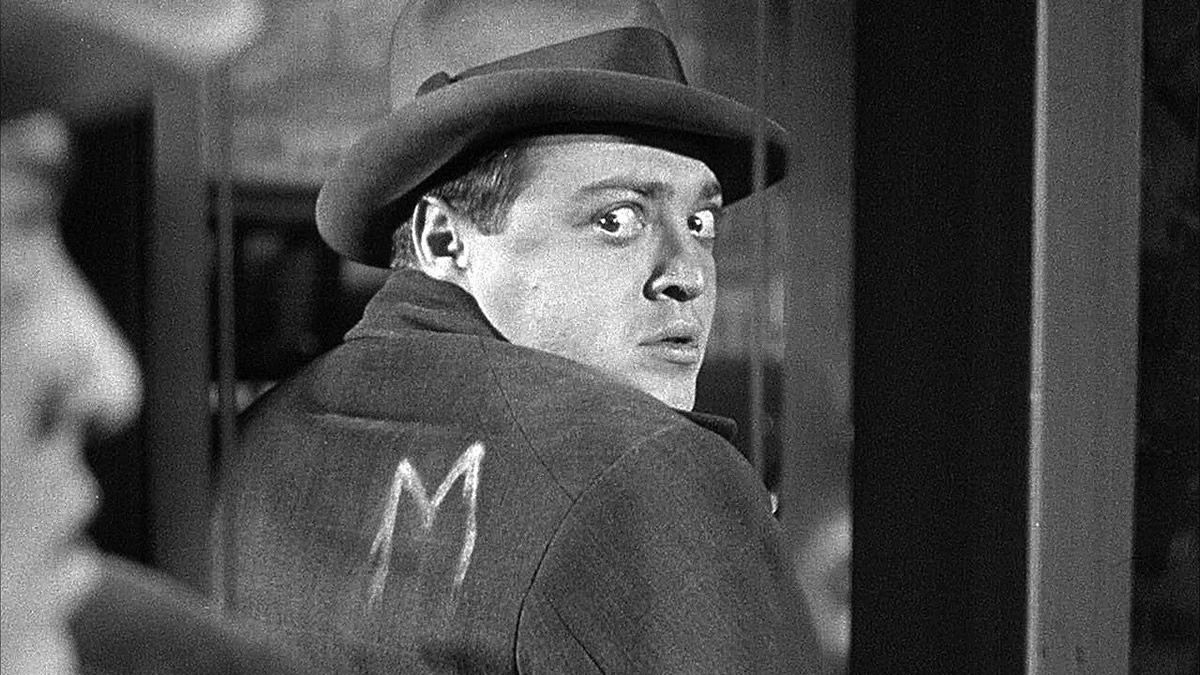
    Which really starts to bother the leading criminals of the city. They’re offended that they’re being lumped in with this killer, and a summit is held by a man known as the Safecracker. He announces that the various criminals of Berlin were now going to work together to track down the killer, and bring him to justice to clear their names, and let things cool down enough for them to get back to work. So, they begin pounding the pavement while the police manage to locate an apartment that Beckert rented, getting further along his trail. But neither group are able to find Beckert until he makes his next move. Because, after Beckert finds another girl suitable to kill, he makes the mistake of taking her to the same blind salesman from earlier, and begins whistling the same tune he had before he killed Elsie. The blind man realizes that this must be the killer, and manages to get a fellow beggar to help mark the man. The other man chases Beckert, and ends up rubbing a piece of chalk in his palm, making the letter “M”, which he hits against Beckert’s back, marking the man as the killer. A group of beggars then begin following Beckert, until he finally realizes something is wrong. He abandons his potential victim, and flees into the night, finding refuge in an office building that he manages to break into. But, the beggars have him trapped, and end up putting a call into the Safecracker, summoning his group of criminals to come and get Beckert.

    The Safecracker and his men then arrive at the office building, taking things over from the beggars. They beat some of the night-watchmen assigned to patrol the building, and begin taking the place apart, searching for Beckert. It takes a while, but they’re eventually able to find the man, and get ready to take him away, when one of the watchmen manages to trigger a silent alarm. The police flee with their captive, but one of their ranks is captured by the police. The police aren’t sure what to make of this strange robbery, until Lohmann manages to trick the man into admitting that they have captured the killer. Meanwhile, the Safecracker has brought Beckert to a distillery where the whole criminal underworld is present for a farcical trial. Beckert is given a chance to plead his case, and he begins trying to get the criminals to realize that he has some sort of insane compulsion to kill these girls, and that he’s not an evil man. He tries to get  them to see that this isn’t his choice, and that they can’t kill an insane man. But, the criminals, many of whom have killed people themselves, don’t really listen to the plea, and get ready to execute Beckert for his crimes, feeling that they will deliver more thoroughly than the police ever will. But, at that moment the police raid the distillery, and manage to arrest Beckert, putting him on a real trial. And, as Beckert prepares to be sentenced by the law, we see the mothers of the slain girls looking on in horror, begging people to watch their children in the face of evil.


    MEnd

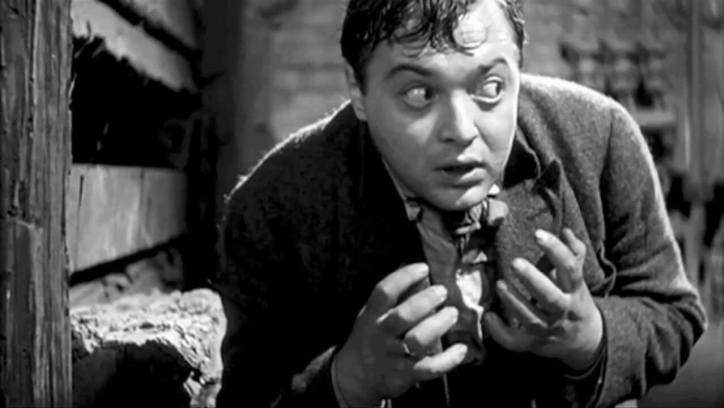
    I had heard about for years. It’s kind of hard not to have learned about it if you’re a fan of movies or have an interest in the world of serial killers. But, I really didn’t know much at all about it. I knew Peter Lorre was in it, and that it had to do with a killer. And, that was really it. So, you can imagine my surprise when it turned out that this movie is less about a serial killer, and more about the criminals of Berlin getting together to track down and capture a serial killer because they know the police aren’t competent enough to actually do it and are just using the hunt as an excuse to put the screws to people. Which, is a really great idea. I mean, during times like these I’m always up to more movies that portray police to be incompetent idiots, because we need more reflections of reality in our media. But, beyond that it’s just a really interesting way to handle a story like this, and one that I don’t think I’ve ever seen before. Plus, it’s just a terrific film to boot. Especially when placed in a historical point of view. I always find it fascinating to see directors who got their start in the Silent era make their first transition to sound, and Lang really goes for it in this movie, using all sorts of then-innovative techniques, and even having a major plot-point revolve around the way the Beckert whistles a specific tune. It’s a gorgeously shot film, trading in the excessive grandeur of something like Metropolis for the grimy reality of Weimar Germany, managing to draw you into the ugly reality of the film remarkably well. That’s also helped along by the stunning performance that Peter Lorre puts in. I honestly don’t have that much experience with Lorre, especially with this German roles, and primarily know him from the fact that he was kind of short-hand for “creepy guy” in Looney Tunes cartoons. But, he really puts in an amazing performance in this film, and you kind of get why he became the poster-child for creeps, playing Beckert with a sort of pathetic malevolence that really felt years ahead of its time.

    And, it’s not just his performance that feels like it’s from another time. This whole movie was kind of fascinating, especially with knowledge of both the serial killer as a concept, and specifically the “serial killer movie.” Obviously, the term serial killer hadn’t even been invented by the time that this film was made, but Lang used quite a bit of real-world horror from various killers who would certainly deserve the identifier if it had existed at the time. But, beyond that, we also have Beckert give an impassioned and repugnant speech about how killing is a compulsion, something he can’t control, something I really didn’t think was talked about in the 1930’s. It plays around with some cutting edge detective work, even if things like handwriting analysis was proven to be bunk, and it really just kind of feels like someone with a modern understanding of serial killers and the way they’re hunted was sent back in time to write this film. But, beyond all of that, it’s just shocking how this film lays the groundwork for what would become the serial killer film. You can definitely fell the influence of this film in things like Silence of the Lambs or Zodiac, and it really does feel like this movie helped forged a template for a type of movie that wouldn’t even have a name for decades to come. But, whereas most modern serial killer flicks are tales about brave police officers fighting against pure evil, this one instead is about a bunch of criminals who get personally offended that they’re being lumped in with pure evil, and want to show that they’re more skilled at hunting out people who don’t belong than the people who make a living doing so. Which, is just a wonderful little twist.


    was written by Fritz Lang and Thea von Harbou, directed by Fritz Lang, and released by Vereingte Star-FIlm GmbH, 1931.


    MKnives

  • Issue 827 – “Double Talk”

    827


    Hi there everyone, and welcome back for yet another installment of Bat Signal, my eternal quest to read every issue of Detective Comics ever published, in random order, and with basically no context. We’re taking another trip to the mid aughts again this week, into that time when Paul Dini was writing the book, and actually let it turn back into a fairly one-and-done mystery book. I’ve grown quite fond of this era of the comic, and this week’s entry is no different. Plus, we get to see one of Batman’s classic rogue’s gallery, which we really haven’t had in a while. And, it’s the Ventriloquist, one of Batman’s most insane bad guys! Although not exactly the Ventriloquist you may be familiar with, unless you’ve read the other time I’ve drawn an issue with them in it. Which, is frustratingly vague, so let’s just dive into the story.

    Things begin on a lonely January night as Batman is driving around the streets of Gotham, patrolling and looking for crimes to stop. And, he’s kind of coming up empty, because no one seems to be out on the streets. That is until he gets a call from the GCPD that a tip has been called in, saying that some men with automatic weapons have opened fire on a woman inside of a warehouse. And, the woman seems to be Catwoman. So, Batman races over to the warehouse, and certainly does find someone dressed up as Catwoman. But, it’s definitely not Selina Kyle, and there’s a crude bomb strapped to the body. Batman manages to flee the building right as the bomb goes off, destroying the warehouse, and finds something odd waiting for him on the Batmobile. It’s a creepy talking ventriloquist dummy of Robin, greeting him. Which, is a pretty big red flag, even in Gotham City.


    827-1


    The creepy little Robin dummy starts negging Batman for a while, until Batman realizes that it’s actually a bomb, and fires his grappling hook at it so that it flies away to explode harmlessly away from the Batmobile. So, clearly the Ventriloquist is involved with this crime, which is a problem, because Arnold Wesker, the man behind the villainous Scarface dummy that is the Ventriloquist, is dead. But, when Batman gets in contact with Commissioner Gordon and Harvey Bullock, they find something shocking at Wesker’s grave. His casket is empty. Which, is certainly strange, but at least the actual Scarface is locked up in police evidence, right? Well, Bullock reveals that when they were dealing with Wesker’s death, the dummy mysteriously vanished. Which, is certainly creepy, but Batman’s sure there must be a logical explanation for all of this. And, to find that explanation, Bruce is going to have to do some research.

    However, apparently the Ventriloquist “killed” Matches Malone a few years ago, so Bruce has to pick a different alter ego, something he apparently has a whole score of. He settles on “Lefty Knox” a criminal with a prosthetic arm that he’s modified to contain all sorts of gadgets. So, Bruce hits the streets as Lefty, and ends up learning about a big party happening at the Penguin’s Iceberg Lounge, seemingly to welcome Scarface back to the criminal world. And, apparently Lefty has an in with Scarface, so he’s able to get into the big soiree, and he starts catching up with two criminals that he knows, Anthony Marchetti and Mr. ZZZ. They take a seat in the Iceberg Lounge ballroom, while noticing an attractive woman mingling with people, getting groped at by some weird biker guy. But, their attention is quickly caught up by the stage, when the Ventriloquist shows up. But, there’s a twist.


    827-2


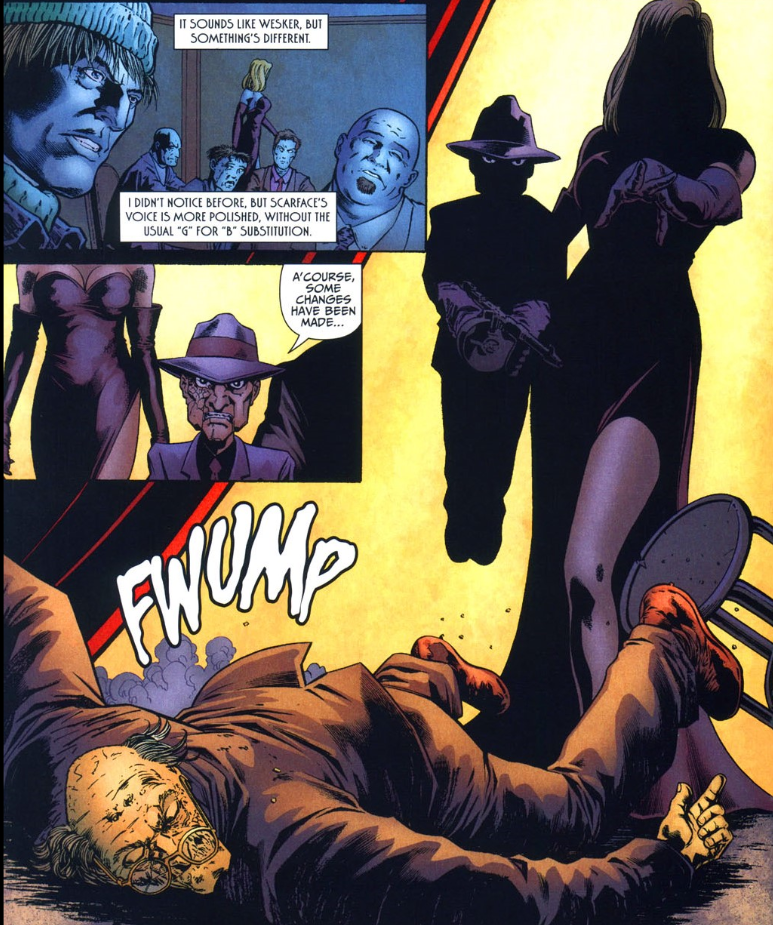
    Well, I guess that solves the mystery of where Wesker’s corpse went. So, as you may know, there’s a second Ventriloquist from this era of the comic which is actually this woman, Peyton Riley, who has found Scarface and taken over the mantle. And, she here to establish herself as the new Ventriloquist. Which begins with her gunning down the guy that groped her earlier, before demanding that people start bowing down to her. She starts using Scarface to give a speech that slowly becomes more of a rant, all about how she’s going to take over the city, starting with murdering Batman. And, while all of this is going on Bruce is using his face prosthesis to take pictures of the new Ventriloquist to figure out who she is.

    However, things starts to get tense when Scarface announces that Batman is on his trail, and is probably pretending to be someone in this room. He then begins calling people out, ready to kill them, until enough people swear they aren’t actually Batman that they decide to just kill everyone. At which point Bruce uses some ventriloquy lessons he picked up from Zatanna to throw his voice, drawing attention to one of the other criminals so that he can cut the lights to the room. He then quickly switches into his Batman costume, as the Ventriloquist and Scarface begin fleeing the building, gunning down everyone they come across. The violence spills out into the casino of the Iceberg Lounge, which is when Batman manages to abduct the Ventriloquist. She then begins frantically thanking Batman, telling him that the Scarface doll is haunted. But, it’s just a trick, because as Batman holds the doll, he notices a slight ticking. So, as he prepares to get rid of the bomb hidden inside Scarface, the Ventriloquist flees. Batman manages to smother the explosion in the giant fake iceberg that the Penguin has built, and then gets to stay there until the police arrive to talk about who this new Ventriloquist may be. And, while that’s happening, we see that she has retreated to an apartment, where she prepares to sleep with one of her many Scarface dolls.


    827-3


    I’ve really become a fan of this particular era of Detective Comics. Paul Dini’s involvement is he obvious culprit, especially thanks to my deep love of Batman: The Animated Series, but I think a big aspect of it is the way that he brought to book back to its roots by writing smaller scale stories that focused on detective-work and were generally one-and-done stories. Which I really love. Yeah, the ongoing saga of this second Ventriloquist spills into subsequent issues, including one that I’ve already talked about where she gets involved in a turf war between Gotham City nightclubs, but by and large it’s a simple little crime story that wraps up by the end of the issue. We get to see Bruce wear a disguise and do some detective work, while also fighting with two ventriloquist dummies that have bombs strapped to them, just to make sure that it’s still a Batman story. Dini must really have an affection for Scarface, and I actually really do like this version of the Ventriloquist, even though I don’t think she’s involved past the Dini-era. Plus, I always love stories that make it seems like Scarface is something serious that we should be afraid of, rather than the silliest thing in the world.


    “Double Talk” was written by Paul Dini, penciled by Don Kramer, inked by Wayne Faucher, colored by John Kalisz, lettered by Jared K Fletcher, and edited by Michael Siglain and Peter Tomasi, 2007.


    827-4

  • The Poppy War and Faith

    PoppyCover


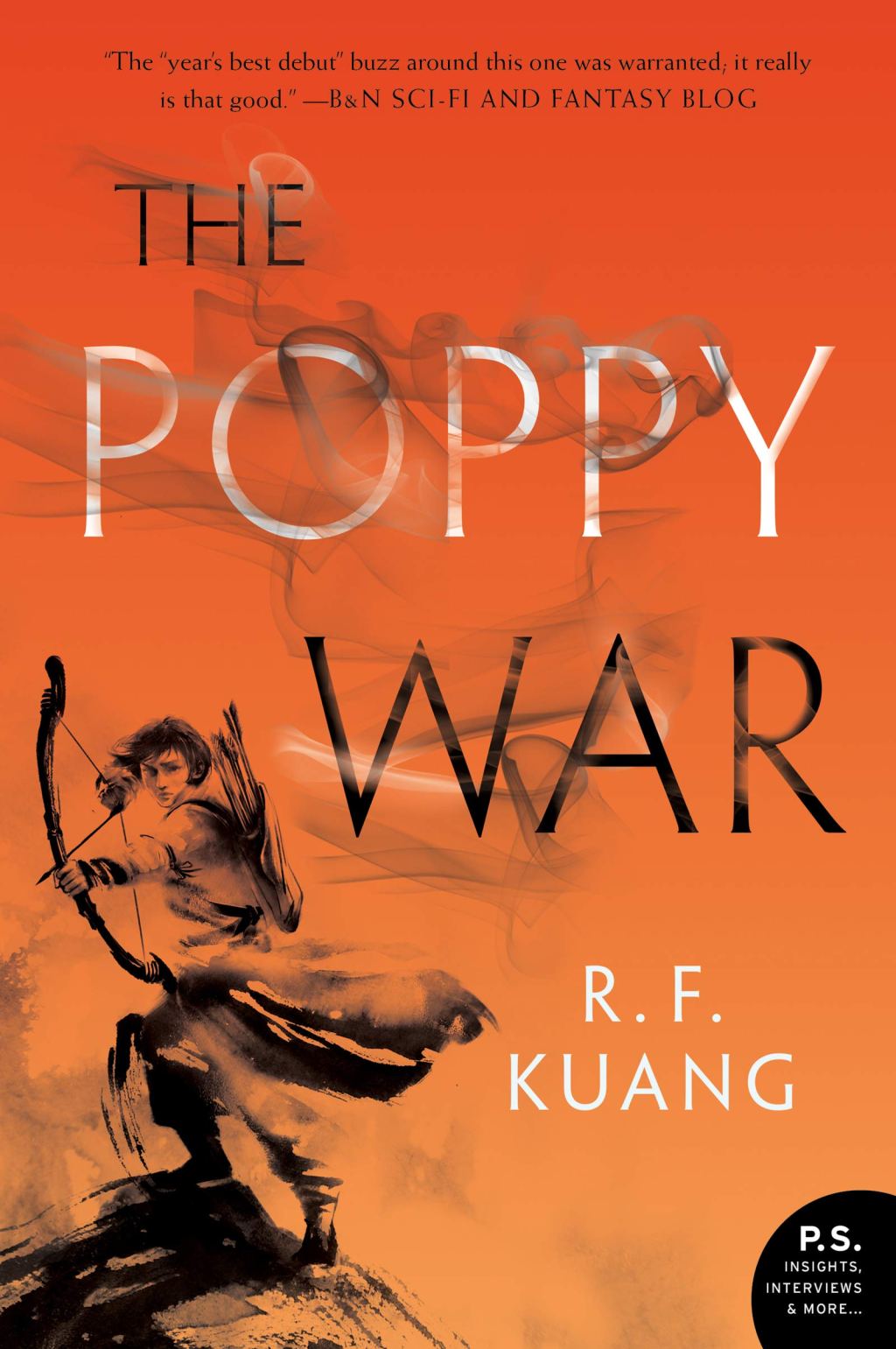
    As I’ve said a few times on the site, I’m kind of purposefully spending 2020 focusing on sci-fi and fantasy novels, just trying to experience a little comfort food genre stuff while the world falls apart around me. And, while I’ve come across some really fun traditional fantasy during this time period, I’ve also felt the need to branch out a bit. Because I think one of the biggest problems with the public perception of the fantasy genre is the idea that it’s all stuck in a sort of Tolkein/Dungeons and Dragons type Western perspective. Just stories full of elves and dwarves running around stand-in’s for Western Europe. But, the whole world has their own versions of folklore and mythology to pull from, and I find myself really connecting with fantasy stories that take other culture’s foundations as the basis for their worlds. I’ve talked about Saladin Ahmed’s great Throne of the Crescent Moon, which told a fantasy story from a more Middle Eastern perspective, and that sent me down a path to seek out some more fantasy novels that try and explore different cultures. Such as the book I’ll be discussing today, R. F. Kuang’s the Poppy War, a fantasy story that pulls off a more Chinese point of view, specifically being inspired by the Second Sino-Japanese War. And, it’s certainly unlike any other fantasy book I’ve ever read, and a hell of a good read.

    The Poppy War takes place in a world similar to Eastern Asia, with the large Nikara Empire in a state of constant turmoil with the island nation of Mugen, representing China and Japan respectively. The Empire of Nikara, which is split into several provinces, has a yearly exam where the best of the best students are sent to the capital of Sinegard in order to train to be the military leaders of the future. And, this test is the only way out of squalor for our protagonist Rin, a war-orphan forced into a life of misery with a drug-dealing family living in the poorest region. But, Rin is able to buckle down and study to the point that she’s able to get a position in Sinegard, heading to the capital to begins learning and forging her own path. Unfortunately, when Rin gets to the capital she finds that most of the other students resent her, seeing her as some sort of token student who isn’t going to last long. She makes a few friends, but is largely pushed aside, having to constantly strive to be better than her classmates. And, it’s during this struggle to become better that she meets one of the more mysterious teachers in the academy, Jiang, who teaches the barely understood subject of Lore. Most students and faculty ignore Jiang, but Rin starts to bond with him, as he teaches her more about the world. Because the whole idea of Lore is the worship of the Gods, something that people generally don’t do any more. Jiang teaches her about the use of psychoactive drugs that can expand ones consciousness to the point that they can communicate and work with the Gods, which Rin starts to believe can be used to grant powers during combat. But, this goes specifically against everything Jiang teaches her, as he attempts to mold her into a monk rather than a warrior.

    However, after a few years at the Academy disaster strikes and the Empire is brought into war with Mugen. The kids are all drafted, and forced into combat as Mugen marches straight to the capital. Things become dire, and Rin ends up embracing Jiang’s teachings, reaching out to a God known as the Phoenix, and gaining its power to kill vast swaths of Mugen soldiers. This makes Rin something of a problem for the Nikara military, who end up sending her to a secretive platoon in the military staffed entirely by people who supernatural abilities. This group is led by a former classmate of Rin’s, Alton, the last surviving member of a race known as Speerlies who worshiped the Phoenix and who the Mugen soldiers exterminated in the last major war. Alton and Rin begin training, and Rin begins to realize that she must be a Speerlie too, due to her immediate connection with the Phoenix, and she works with Alton to fight against the invading forces using their magic. But, it’s not enough, and eventually Alton is led to the point where he and Ren decide they need to go free other magic-wielders from a supernatural prison in Nikara, home to people who have been completely subsumed by the Gods they worship. They manage to free one of the men, who has gone completely mad and wants to destroy the world, only to be abducted by Mugen soldiers. Alton ends up sacrificing himself to destroy a Mugen research facility where they’re trying to solve the question of how he and Rin communicate with Gods, letting Rin escape and reach the destroyed island of Speer. There she’s able to give herself completely over to the Phoenix, fueled by rage, and letting it run wild. Which results in it using its power to trigger a series of volcano under Mugen, killing thousands of people. So, Rin is let with the knowledge that she may now be the greatest killer in history, along with the task to having to deal with the God she let escape earlier, and knowing that it’s up to her to stop him.

    The Poppy War is a novel that really keeps you on your toes, becoming very different sorts of stories as it progresses, all of which are captivating. I didn’t really know much about it going in, and so when things were first starting I kind of settled into the idea that it was essentially going to be Harry Potter, just following Rin as she went through the struggles of dealing with a strange school situation while also learning that she can use magical powers if she trips out with a God. But, as soon as the war breaks out things become something very different as Rin gets to run around with an elite strike-force of drug-popping wizards, getting involved in all sorts of crazy battles. And, then things take a much darker turn there at the end as Rin gets to become some sort of metaphysical terrorist, while setting up an ongoing narrative that will get more and more mystical as it goes on. And, it all works beautifully. Kuang is a great writer, and she really guides the reader through Rin’s rise and fall, making her slide into a state fueled by hate and vengeance seem natural. Rin may have become a villain by the end of the book, but her journey down this dark path is handled in such a way that you never really question it, and just have to sit back and lament her choices.

    One of the things that I always find most interesting about fantasy novels is how they grapple with the idea of magic. It really  does seem to be one of the biggest issues that an author has to deal with while building up their world, either by just deciding if it’s going to be present or not, and how it will be implemented. And, I think I can easily say that I’ve never seen another fantasy story that tackled magic quite like this. The idea of getting magic through devotion to a God is unique enough, but having the only way to commune with your gods be by expanding your mind with drugs really gets points for originality. But, beyond just being unique, it also ends up being a really fascinating exploration of faith, and the way that it can be twisted. Jiang does his best to teach Rin that her faith and abilities are something to be honored, something to take deadly seriously. It’s a process of respect. But, that’s not in the interests for those around her. She’s in a military academy, and she’s taught that she needs to take this knowledge, and bend it to a destructive path. She takes a personal thing and is forced to wield it like a weapon. And her faith is used to kill thousands of people. I’m really interested to see where the story goes from here, and how Rin’s exploration of faith will be tested with the knowledge that she was used a weapon.


    The Poppy War was written by R. F. Kuang, 2018.

  • The Vast of Night and Throwback Sci-Fi

    VastPoster


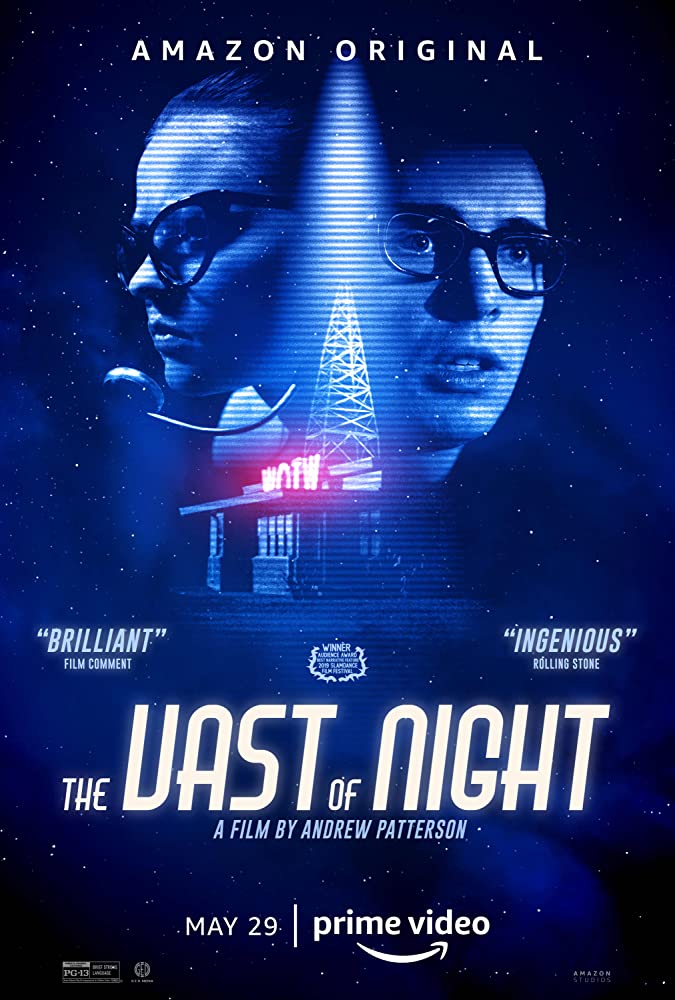
    Well, the world’s in pretty terrible shape, isn’t it? As if living through a generation-defining pandemic wasn’t enough we’ve also gotten the joy of watching America become more open about it becoming a fascist police state as protests around the country are turned into nightmares. And, it’s really hard to figure out what you can even do in a time like this, and after donating time and money you may end up like myself, just kind of paralyzed with self-doubt and frustration. And, if you’re also like me, you may be attempting to sublimate that frustration with some media. Which, is of course a potentially frustrating approach, since we really aren’t getting that much new media, especially new movies. So, in my eternal search to find something new to watch for a little self-care, I’m always going to jump at the chance to check out something that’s getting positive buzz. Which is how I came across a new Amazon Prime original film, The Vast of Night. I didn’t really know anything about it, other than seeing people give it very positive reviews while saying that it felt reminiscent of a 1950’s sci-fi flick. Which, is certainly a genre that I find a little comforting, primarily due to my obsession with Mystery Science Theater 3000, even though those films don’t often portray the best aspects of 1950’s sci-fi. So, while being a little concerned that I was about to watch a movie about a bunch of greasy guys hanging out in laboratories talking about an alien that they didn’t have the budget to show for more than ten seconds, I checked the movie out, and was really pleasantly surprised by a movie that manages to throw back to a style of sci-fi film-making that doesn’t really exist anymore, while showing that it’s just as powerful today as it was back then.

    The film, which is structured like an episode of a Twilight Zone-esque show called Paradox Theatre, takes place in a small town in New Mexico called Cayuga in the 1950’s. We follow a young man named Everett who appears to be working at a local radio station in the night while still attending high school as he responds to a request for help with the school’s electrical system. And, along the way he runs into Fay Crocker, another student who is clearly enamored with Everett and who has dreams of becoming a scientist, leading America into a technologically advanced future while working as a switchboard operator in the small town. The two chat for a bit, before Everett heads off to record his show while Fay works at the small switchboard. But, while listening to Everett’s show Fay starts to overhear a strange signal broadcasting through Everett’s show. And, what’s more confusing, she starts to get calls to the switchboard that alternate between people outside of town calling in horrified confusion, and the signal itself. Fay manages to get a hold of Everett, and have him listen to the signal, and they confirm that it’s been playing throughout his show. They aren’t quite sure what to make of the signal, and end up playing it out over the air, asking people to call in with ideas of what it might be.

    And, shortly after, Everett gets a call from a man claiming to have been a former soldier in the military with a story to share with them. He tells them about a series of clandestine missions that he and other soldiers have been sent on in the last few decades, which make him convinced that the sounds are signals between alien spacecraft. He gives some evidence to the listeners that aliens have been watching humanity for a while now, and ends up leading Everett and Fay on a hunt around town for more proof. The meet up and begin travelling around their small town, talking with people who are hearing the strange sound, and some who are seeing strange phenomena in the sky. And all of this eventually leads the pair to meet an older woman living in town, who tells them a story about how her son was kidnapped by aliens, who she believes are secretly dominating the human race. They’re rather put off by the woman, especially her insistence that she comes with them to find the aliens so she too can be abducted and reunited with her son, and end up fleeing. But, that sends them down a path that leads out of town, where they indeed come across some sort of alien craft hovering over their town, listening to them, and studying them.


    VastRadio


    I enjoyed myself with the Vast of Night. It’s included with Amazon Prime, so if you have the ability to check it out I recommend giving it a shot, especially if you’re into sci-fi. But, it’s not going to be for everyone. It’s a pretty slow movie, and I’ve seen some people have somewhat negative reactions to it for that reason, arguing that it feels like something that could have simply been a radio drama. But, I kind of enjoyed that about it. It’s obviously leaning into something of a Twilight Zone aesthetic, and I think it accomplishes that nicely. It’s a tight little sci-fi flick full of actors who I’m not at all familiar with, telling a stripped down story that manages to pack in some good moment and cool ideas. It’s not going to set anyone’s world on fire, but I thought it was a fun little movie. It’s certainly unlike most things we get these days, throwing back to an older style of sci-fi filmmaking, while managing to be a best case example of it.

    Like I said earlier, when I heard people saying that this was a bit of an homage to 1950’s sci-fi flicks my initial assumption was that it was going to ape the B-Movie trappings. It would be about aliens, but primarily be about people sitting around in laboratories talking about aliens rather than showing anything. And, while it still does end up being a movie that’s mostly about people talking about a mystery, it manages to get higher marks by also homaging one of the central themes of 1950’s sci-fi cinema, at least the most successful entries. It’s a movie about paranoia. The 1950’s were a strange time for America, and science-fiction managed to capture that feeling by telling stories of people constantly stressed out about everything around them. The Cold War was breathing down their necks, the space race was beginning, and science was pushing Americans further into the future than a lot of them wanted to be taken. So, the came up with stories about aliens hunting them, and forces out of their control listening and studying them. And, this film manages to get across that paranoia and horror in a way that shows you that things haven’t really changed all that much. The world is still a nightmare, and we literally have things listening to us all the time. The paranoia of the 1950’s is alive and well, and I’m kind of hoping we get a resurgence of low-budget movies like this that take advantage of that.


    The Vast of Night was written by James Montague and Craig W Sanger, directed by Andrew Patterson, and released by Amazon Studios, 2020.


    VastCouple

  • 9. Super Fly

    SuperPoser

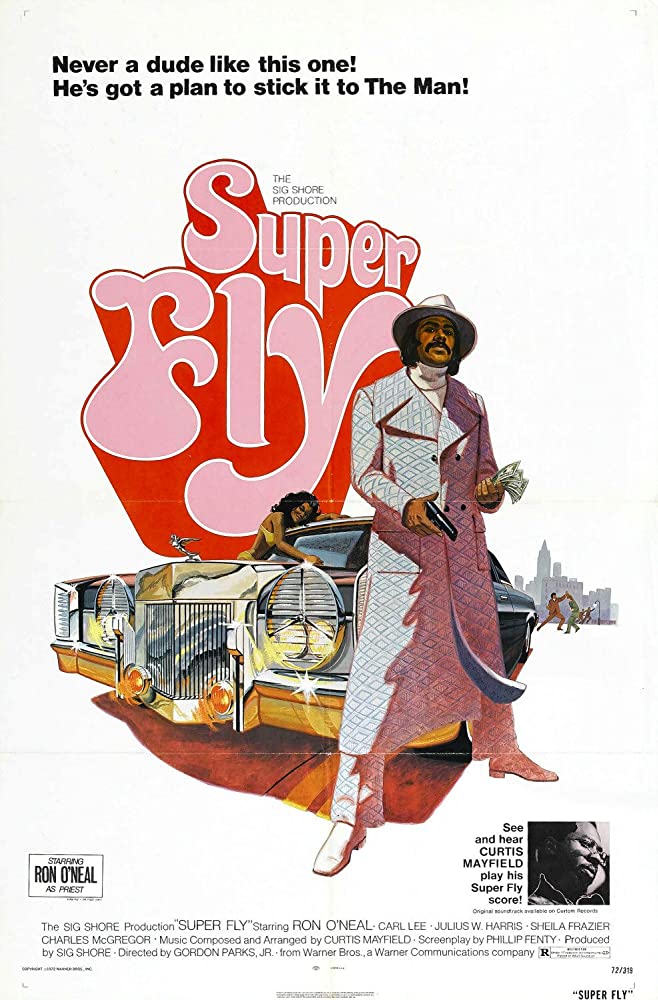
    One of the aspects of this new project that has been the most fun to me has been the way that I’m able to completely vacillate between radically different tones and genres, week by week. I’m able to jump between comedy, action, sci-fi, noirs, fantasy, Westerns, and now apparently Blaxploitation.  I was honestly pleasantly surprised to see today’s film, the seminal work of Blaxploitation cinema Super Fly show up on my list this week, partly because I’m just kind of stunned that it was included in the list. Not to say anything bad about Super Fly, I actually really enjoyed it, but I was not expecting the writers of 1,001 Movies to See Before You Die to be hip enough to include a movie like this. It really helps cement the idea that I chose the right source for these random movies, because I’m getting to check out a variety of really fascinating pieces of cinema. I’ve generally been a fan of the Blaxploitation subgenre for a while now, partly due to my college-age obsession with cult movies, many of which ended up falling into or adjacent to the Blaxploitation genre. But, I will also admit that a majority of my knowledge of the genre has come second-hand, through movies that were clearly influenced by Blaxploiation rather than the foundational works of the genre itself. Movies like Black Dynamite show the more ridiculous side of the genre, and movies like Jackie Brown helped foster an understanding that the movies were about more than simple insanity, and often had something deeper going on beneath them. And, through an appreciation of these more modern love-letters to the genre, I’ve seen a handful of the classics, things like Coffey or Shaft, that kind of show everything great about the genre, warts and all. But, if there’s one towering figure in the genre that I’ve never seen before, it would have to be Super Fly. It’s a movie whose shadow looms large in the world of Blaxploitation, partly thanks to its incredibly famous soundtrack, but for whatever reason it’s one that I’d never gotten around to. And now, thanks to this weird project, I got to check it out for the first time, and it’s a hell of a thing.

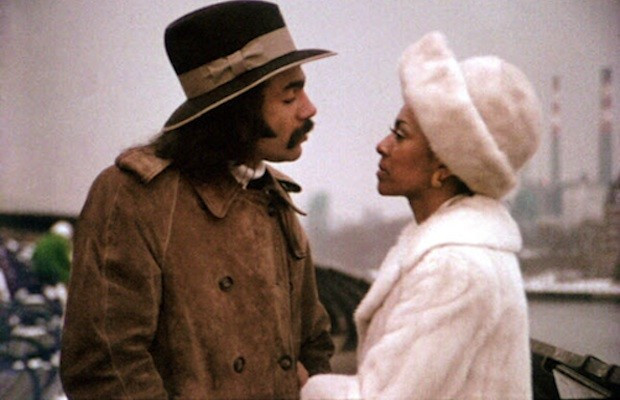
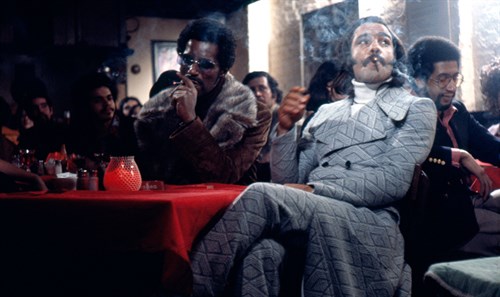
    No explanation of Super Fly would be complete without an understanding of the Blaxploitation genre. Hollywood has always been rather uninterested in putting much money or work into making movies that aren’t targeted directly towards white men, but they also are eager to find any way to make more money. So, during the late 1960’s and early 1970’s when a rise in lower-budget and more amateur-made films were getting released, and finding success among people, they sought out to find movies that would appeal to demographics that were starved for representation. And, after the one-two punch of Sweet Sweetback’s Baadasssss Song and Shaft it became clear that the studios could make some money off of black audiences who were eager to see movies that were largely made for and by their community, even if they were mostly crime films about drug dealers and pimps. The studios still weren’t that interested in spending much money making the films however, and largely bought up independently produced films, including Super Fly, a film directed by Gordon Parks, Jr the son of Shaft’s director Gordon Parks. Parks, Jr was predominately a photographer, but after his father’s successful film helped introduce a new genre he decided to try his hand at bringing a story of the black community to life. Working with a black screenwriter named Phillip Fenty the two started to craft the story of Super Fly, telling the story of one criminal looking to make one last score before he can go straight, surrounded by actual on-location filming in Harlem, real-to-life costuming and set decoration, and a stunning soundtrack from funk icon Curtis Mayfield. And, after getting in business with white producer Sig Shore, the movie was able to be picked up by Warner Bros., who were more than happy to make quite a bit of money off of this low-budget film that was created by a most black cast and crew. The film was a huge hit, especially considering its meager budget, and has gone on to gain a reputation as being one of the best examples of the Blaxploitation gene, despite arguments that its subject matter only helped influence stereotypes of black culture at the time. And, while it’s hard to deny that the movie slides into stereotype quite a bit, it’s still stunning to see a movie like this, made the way that it’s made.

    SuperPair

    Super Fly tells the story of Priest, a pimp/cocaine dealer living in Harlem, and enjoying the high life. He’s got money, women, drugs, and power, and yet he’s yearning for something more. He’s tired of constantly looking over his shoulder, and dealing with the never-ending grind of making a living through crime, so he decides it’s time to try to get out of the life of crime, and try to live on the straight and narrow. But, to accomplish that he’s going to need money. So, he comes up with a plan that he shares with his partner Eddie. Basically they’re going to go for one last score, take all of the money they have saved up and buy as much cocaine as they can in order to earn $1,000,000 in four months, at which point the can split it and go their separate ways. Eddie doesn’t really seem to be into the idea, enjoying his life of crime, but Priest insists that it’s the way things are going to be, and starts going around town, getting money from everyone who owes him anything, and trying to find a good source of cocaine for their final score. And he thinks he’s found that source in a man known as Scatter, a former dealer who Priest knew back in the day who is ostensibly retired and running a restaurant. Priest and Eddie talk with Scatter, who doesn’t really want to help them, and wants to continue being retired. Eddie’s hothead doesn’t help matters either, but Priest is eventually able to break through to Scatter, who connects with Priest’s desire to leave the life behind, and encourages him to get out while he’s young so he doesn’t end up like himself. So, he agrees to get them the cocaine they need from his supplier.

    Priest and Eddie then go to celebrate, ready to embark on this final big score. And, along the way they meet up with a one of their dealers, Freddie, who Priest had already visited in order to demand some stolen money. Freddie pays up, and claims that they’re square now, but things get problematic the next night when Freddie is out fighting. He gets picked up by the NYPD, who begin pressing him for information about his drug connections. And, to save himself, he starts telling them everything about Priest and his big score, even telling them where he and Eddie are set to meet Scatter’s source. Priest obviously knows none of this, having spent the day with his girlfriend Georgia, doing his best to plan a future free from all of his crime and drugs. So, he and Eddie go meet Scatter and get their cocaine, only to immediately be arrested by some corrupt police officers. The lieutenant that’s running the gang reveals that he’s been Scatter’s supplier, and that he now wants to control Priest and Eddie, and have them deal cocaine for him, otherwise he’s going to bust them. He’s going to give them as much cocaine as they need, but they essentially belong to him now.

    After this experience Eddie is pretty happy with how things turned out, since he didn’t actually want to get out of the life, but Priest is furious. He still plans on getting out  as quickly as possible, so he begins selling the cocaine they got from the cops as efficiently as he can. He’s ready to put the life behind him, and find a quieter, slower-paced way to live, when things get even more complicated. Because Scatter shows up, claiming that the cops are after him now that he’s no longer necessary. He explains that this whole corrupt police gang is ran by Deputy Commissioner Reardon, and even has some blackmail materials to use against Reardon. He gives the blackmail to Priest in exchange for some money to flee the city. However, as he gets ready to flee Scatter is caught by the police and murdered. Priest then realizes he needs to get out now, and gets his half of the money from Eddie, ready to leave the life. Eddie is mad at him though, and ends up calling the cops to come and get Priest. But, he assumed Eddie was going to pull something like this, and managed to slip his money to Georgia before getting picked up by the police. He’s then taken out to the waterfront where he’s confronted by Reardon for the first time, who begins threatening him to do what he’s ordered to do. But, Priest manages to fight several of the cops, before revealing his knowledge of the blackmail, and has hired some killers to murder Reardon’s family if anything ever happens to him. At which point Reardon lets Priest leave, who goes to find  Georgia and start his new life.

    SUperCouple

    Blaxploitation movies aren’t going to be for everyone. Hell, they may not even be most crime-film fan’s cup of tea. It’s a very specific genre, capturing a very specific time period. And, at its core, it’s exploitation cinema, something that really doesn’t exist these days, at least to the degree that it did back in the 1970’s. I suppose weird direct to VOD stuff is as close as we can get to these sorts of super low-budget movies that would play in little theaters and drive-ins, and were mostly designed to be short and scandalous so they could program them for profitable double-features. But, if it’s an aesthetic that you can get behind, I really do think that this is probably one of the best examples of the genre. I’ve seen other Blaxploitation movies from this time period which maybe look a little slicker, or feel closer to Hollywood productions, but this is a movie that really encapsulated the genre perfectly. It’s a really gritty film, full of shaky and effective camera-work that captures the reality of early 1970’s New York in a way that manages to feel more authentic than amateurish. It’s a fascinating time-capsule of a film, in terms of the film-making, the aesthetics, and of course the music. Curtis Mayfield’s soundtrack has perhaps become more famous than the film itself, and it is a very wonderful soundtrack, but people who look past the film are missing something really interesting.

    Because, at the risk of sounding a little too pretentious, Super Fly is kind of the Platonic Ideal of a Blaxploitation movie. It’s everything that the parodies and homages are referencing, while also serving as an excellent example of why this genre was so important. One the one hand, the movie is exatly what you think of when you think of  a Blaxploitation movie. It’s got a killer funk soundtrack, it’s a story about a guy who is both a drug dealer and a pimp, it’s about black people trying to survive pitted against some shitty white authority figures, everyone is wearing stereotypical clothes from the era and driving big pimpmobiles, and it even features some karate. But, on the other hand, it’s also a movie that was written and directed by black people, was predominately crewed by black people, and starred almost exclusively black people. It’s a scrappy movie, made on a shoe-string budget, that managed to become a huge financial success, and a massive cultural touchstone. It was an indie movie, in the purest sense of the word. It’s a passion project, something made by people who the studio system largely ignored, telling a story about their world, in their own way. Yeah, unfortunately the constraints of the distribution systems made it so that the only way for such a movie to get released was to focus it on drugs, sex, and violence, but it’s still a way into the world of cinema. It’s a sign that if you have the story to tell, and the audience to pick up on it, you can break through the system and tell a story on your own terms.

    So, yes, I would recommend that people check this movie out, and cross it off their own personal Bucket Lists. It’s not going to be for everyone, but if you have any interest in Blaxploitation, even if that solely comes from things like Black Dynamite or Jackie Brown, then I think it’s worth checking out, and seeing where it all comes from, in its purest form.

    Super Fly was written by Phillip Fenty, directed by Gordon Parks, Jr, and released by Warner Bros. Pictures, 1972.

    SuperSmoke

  • Issue 301 – “The Condemned Batman”


    Hello everyone, and welcome back for yet another installment of Bat Signal, my never-ending quest to read every issue of Detective Comics ever published, in random order, and with essentially no context. And we’ve got a real goofy one on our hands this week, folks. It’s the special brand of Silver Age Batman story that just feels a tad phoned in. Weird premise, odd villain and shaky exposition. But, if you’re into that sort of thing, which I’ve kind of grown accustomed to, sit back and relax, and let’s chat about the time Batman became so hot he had to live in a plastic bubble.

    The story begins kind of in the middle of things, with Batman and Robin chasing down a pair of goons who are attempting to rob some sort of laboratory that makes artificial gemstones. The men seem to be stealing fake gems, which is an interesting call, and are trying to flee, with Batman and Robin hot on their heels. Which gives them the idea to huck some of the gems down on the ground, causing the Dynamic Duo to slip and fall, and giving them a bit of a head-start. Batman catches up quickly though, but doesn’t notice that one of the men seemingly vanished. And, as Batman reaches a small alcove the guy leaps out of the shadows and pushes him through a door, into one of the laboratories. And, Batman finds himself sprawling out on a large platform covered in gemstones that’s being bombarded with strange, vaguely defined rays of energy. Which means that Batman is now being bombarded with those rays as well. And this process has an almost immediate effect on him, causing him to glow with a red light, and put off an insane amount of heat, to the point that it ends up causing enough pressure in the room to cause one of the walls to fall apart. 


    301-1


    Robin tries to come help Batman, but he’s putting off too much heat to even get close to. Thankfully they’re found by a scientist who works at the laboratory, and he informs them that he has no idea what’s going on, but says that they need to stick Batman in an experimental plastic capsule in order to not cook everyone around him alive. So, they stick Batman in the little capsule, and start doing some tests on him, finding that one of the side-effects of this transformation is that he now breathes methane. Which, seems like he’s going to be trapped in his little plastic prison forever. But, Batman has different plans. He has Robin work and create a little ship for him, that can keep him breathing methane, while flying around with compressed air rockets, and fighting crime with robotic tentacle arms. Which, weirdly seems to work okay, letting Batman adjust to this strange new life.

    But, all of this ends up catching the attention of a local mobster named Brains Beldon, who has come up with a plan to steal quite a bit of money, using Batman’s current situation. Because the next day Batman and Robin have agreed to oversee a transfer of $20 million. And, while they’re keeping an eye on the trucks carrying the money we see Brains call Commissioner Gordon, claiming to be a doctor who has cracked a cure for Batman’s condition, but tells him that they need him to come to the hospital as quickly as possible. So, Gordon gives Batman a call, and he and Robin decides to race to the hospital, leaving the cash transfer in the hands of the bumbling police of Gotham City. And, as Batman’s little rocket thing approaches the hospital he’s suddenly attacked by Beldon’s men, who shoot a big net at Batman, causing him to sink down so they can crack his little egg open.


    301-2


    The criminals begin spraying Batman’s little dome down with liquid oxygen, causing it to crack open and free him. Which Robin can’t abide. And, since he was driving behind in the Batmobile he comes racing up behind the goons, driving into a fire hydrant so that it starts spraying water at the criminals, keeping them incapacitated. Batman then radios Commissioner Gordon and informs him of the strange criminals, causing Gordon to order all available cops to come arrest them, including most of the cops who were guarding the cash transfer. Which is when Belden and his men arrive, pretending to be backup officers, offering to drive the truck full of money the rest of the way. 

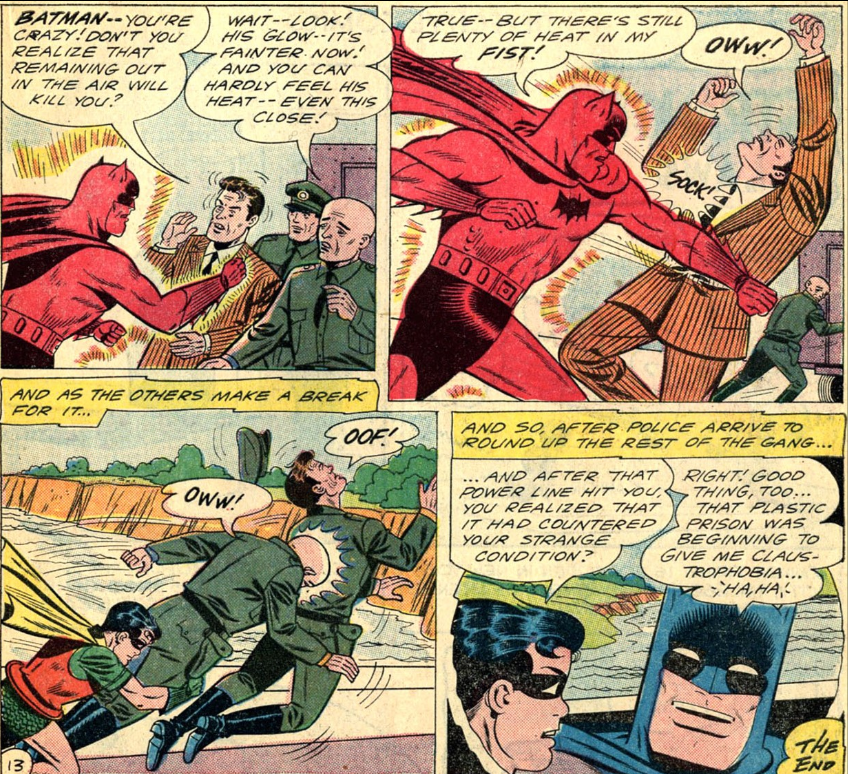
    But, when the police come to arrest the criminals with the liquid oxygen, we see that Batman has realized they’ve fallen into a trap. He assumes that this was all a distraction from a larger job, and they realize it had to have been the cash transfer. So, he flies off to the transfer route, and finds Beldon and his men fleeing in the truck carrying the money. Batman begins chasing the truck, which eventually drives up to a large dam outside Gotham City. Beldon and his men then race inside, and begin opening the dam, causing it to flood the city below as another distraction. Batman can’t do anything to stop them, but comes up with one idea. He lands his little ship and gets out of it, using his insane heat to melt the power cables charging the dam, which would cause the floodgates to automatically shut. And, in the process, he’s hit by a downed power cable, which electrifies him. Beldon and his men then head out of the building, ready to fight Batman, because they know that he can’t breathe without methane. But, it turns out that the electrical charge of that cable has somehow cured his condition, and Batman’s able to put a stop of Beldon, and say goodbye to his little Dr. Robotnik craft.


    301-3


    So yeah, this is a weird one. I feel like there are two dominant types of Batman stories from this era. Ones where Batman encounters some weird gimmicky villain who will only appear in one issue, and ones where something insane happens to Batman and he just turns into some science experiment for an issue. And, I definitely like the Batman science experiment ones less. Some of them work, but some of them feel a little slap-dash. Like this one. I mean, I’m not expecting pure scientific reasoning in sixty year old issues of Detective Comics, but I have no idea what’s going on with this issue. Batman gets hit by electricity and becoming some sort of living sun, only able to breathe methane, until he’s hit by different electricity, like he’s Fred Flintstone getting knocked on the head and reverting back to his old state. It’s not the best issue I’ve ever read, but it’s also not the worst. It’s just sort of fine. A standard unit of Batman comic. 


    “The Condemned Batman” was written by Bill Finger, penciled by Sheldon Moldoff, inked by Charles Paris, and edited by Murray Boltinoff and George Kashdan, 1962.


    301-4


  • That Time the Hulk Led a Museum Mutiny

    MuseumCover


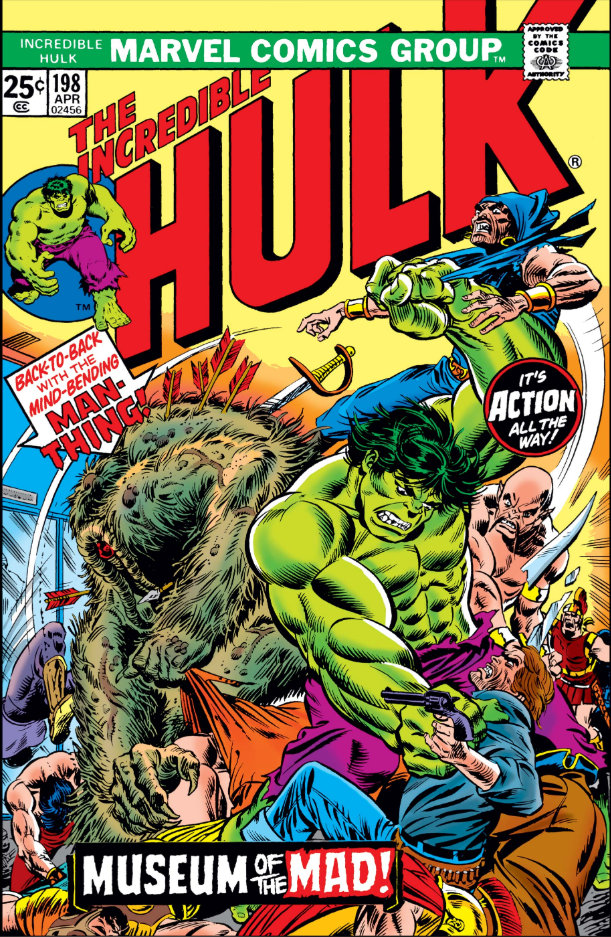
    If you’ve ever read any of these Marvel Madness posts, it becomes quite clear that there are certain things that will almost guarantee I choose a story to highlight. I generally am working through the various runs of the big Marvel characters, and seeing certain elements will make me stop in my tracks, ready to find a story custom-made for these sorts of posts. The most obvious of which is Doctor Doom showing up in a comic that’s not Fantastic Four, but I worry I’ve been over-fishing that particular lake, and may be approaching a point where there just aren’t that many stories left that work that well. But, there are plenty of other fun little flags I can come across while scrolling through Marvel Unlimited, such as anything involving actual Marvel staff, insane cameos from real people, the Juggernaut, and perhaps one of my favorite relatively obscure C-List characters, the Infernal Man-Thing! I haven’t talked about the Man-Thing nearly enough on the site, but I really love that big old ball of gunk. I know he obviously gets compared most often to Swamp Thing, since on the surface they’re incredibly similar characters, and in that competition Man-Thing almost always loses, since he just doesn’t have as many classic stories or beloved runs as Swamp Thing does. But, there’s something incredibly endearing to me about his weird character, so whenever I see him involved in a comic I come across I’m going to get excited. And, when I get the promise of seeing him play with the Hulk, the Collector, and a whole bunch of time-displaced henchmen in a magical museum, I’m bound by law to share it with you all.

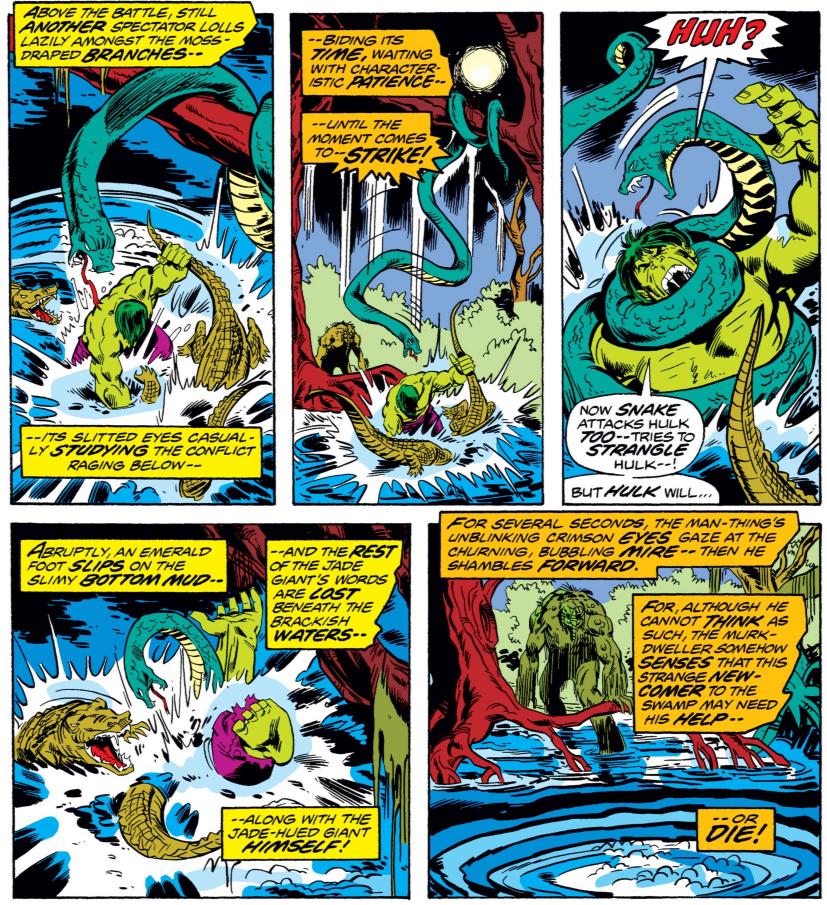
    The story begins, as so many Hulk stories do, with the jade giant lumbering through a new location, pissed off that he’s here. And, this time he’s marching through a swamp in the Florida Everglades, absolutely hating that he’s here, and not quite remembering how he get there. But, as always, he’s looking for a little peace and quiet, hoping to get away from all the meddlesome humans who always cause him such aggravation. And, as he’s wading though some swamp water, complaining about his latest encounter with the Abomination, he suddenly gets attacked by a trio of alligators, who attempt to take down this massive feast. But, the Hulk isn’t going to be taken down by lowly lizards, so he just start rasslin’ him some gators, when we the reader notice that this brawl has gained the attention of the Man-Thing, who just kind of awkwardly watches as the Hulk beats the shit out of the gators. And, while he’s watching things get even more complicated when a large python attempts to strangle Hulk while he’s busy dealing with the gators. And, the snake is actually able to give Hulk some problems, choking the breath out of him, causing him to sink into the swamp, being devoured by alligators, while the Man-Thing just watches.
     

    MuseumSwamp


    But, after just a moment, the Hulk comes bursting out of the water, holding a writing mass of reptile, after having tied the alligators up with the python. He then hucks this pile of terrified animals out of the swamp, before happily stomping away, pleased at a job well done, all while the Man-Thing just kind of wanders off, bored with the proceedings. And, as Hulk continues to wander through the swamp, he ends up encountering the ruins of a couple geodesic domes, which used to house an experimental city known as Omegaville, which frequently shows up in various Man-Thing comics. The place has been utterly destroyed by something, and Hulk just kind of snoops around, seeing a bunch of skeletons frozen in poses of terror. But, that doesn’t really interest him. What does interest him is a fairly well put together bed, which survived whatever happened to Omegavile. So, deciding he deserves a good night’s sleep, the Hulk takes a load off, and falls asleep on the bed, gradually turning back into Bruce Banner.

    And, as Banner sleeps we see a mysterious person arrive at the shattered dome, and creepily watch as he slumbers. The guy apparently stands there the entire night, until Banner finally wakes up, only to find the guy lurking in the darkness. Banner realizes that he’s in Omegaville, which he’s vaguely familiar with, and ends up chasing the guy down, figuring he had something to do with the destruction of this experimental city. But, when Banner finally manages to tackle the guy, he finds that something seems to be very wrong with him. He can’t speak, and he generally acts like a frightened animal, wanting to just run away and hide. So, not quite sure what’s going on, Bruce decides to be nice to the guy, and begins walking through the swamp with him, trying to soothe him and get hi to calm down.

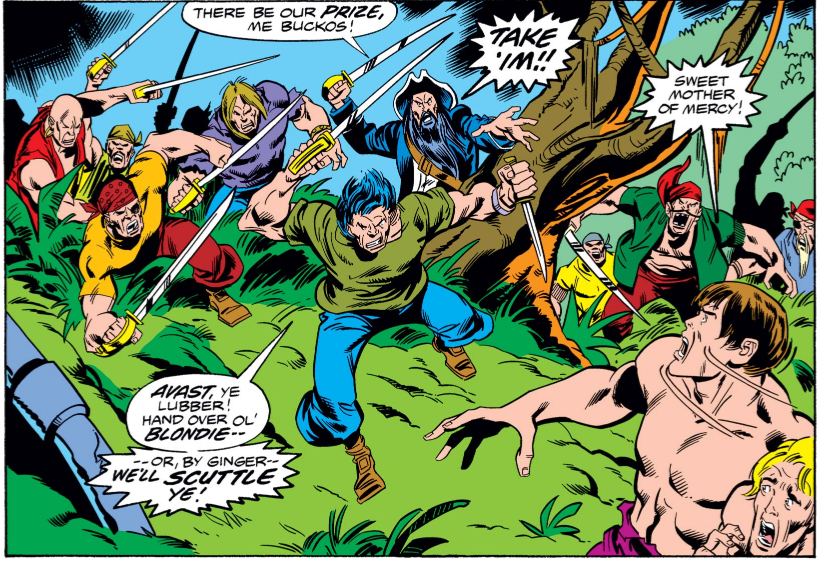
    Which is when the pirates show up.
     

    MuseumPirates


    Well that’s unexpected! Bruce and the mute guy are suddenly jumped by a bunch of pirates, leaping out of the swamp to capture them. Bruce freaks out, and the blonde guy really begins panicking when the pirates appear, so Bruce does his best to protect the guy. Especially when the pirates announce that they’re here specifically to capture him, and bring him back to their employer. But, Bruce isn’t going to allow an innocent guy to get captured by a roving gang of pirates, so he does his best to defend him. The pirates find that rather ridiculous, and just attack Bruce, dog-piling him and beating the crap out of him. Which, was a miscalculation on their part, because all this accomplishes is triggering his transformation into the Hulk. At which point the Hulk begins beating the shit out of the pirates, who still attempt to steal the blonde guy.

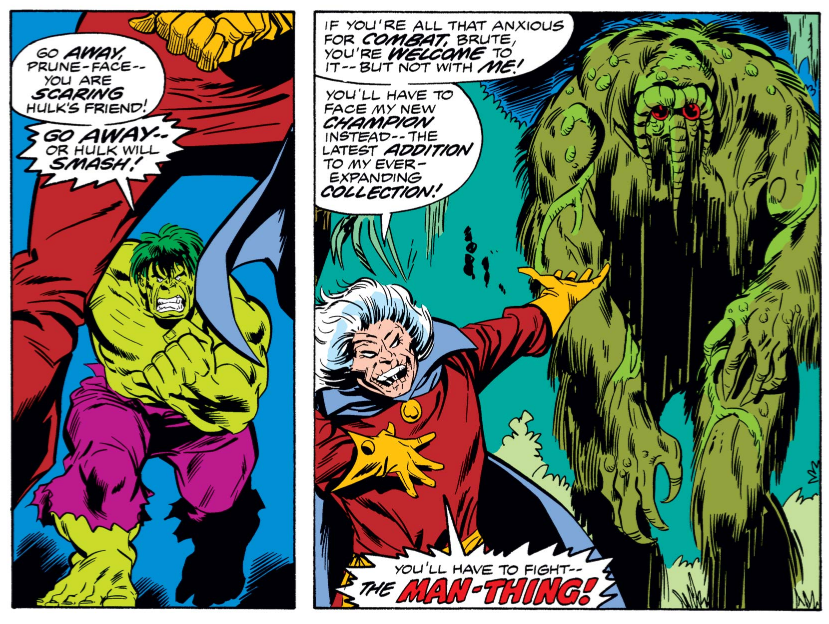
    The Hulk is pretty baffled by all of this, not sure why he’s being attacked by pirates, or why he feels the need to protect this blonde guy, but he just goes with it and continues beating on the pirates. And, after a while of fighting a giant indestructible green monster, the pirates start to question why exactly they’re doing this as well. But, as the Hulk continues to batter the pirates, they’re suddenly joined by the employer of this group of buccaneers. The Collector! Now, you are more than likely most familiar with the Collector from his appearances in the Marvel movies, and they do a fairly good job at getting across his whole deal. He’s a being who has been around for almost the entirety of the universe’s existence, and he’s obsessed with collecting things. He often shows up on Earth to try and kidnap the various odd people who live there, and it appears that he’s after this blonde guy. But, he’s also interested in picking himself up a brand new Hulk. And, luckily for the Collector, he’s just picked himself up some new muscle.
     

    MuseumFight


    I’m not exactly sure how the Collector manages to wrangle the Man-Thing into this whole thing, but he’s not exactly the brightest bulb in the bunch, so I guess it tracks. And, the Hulk doesn’t really need much to convince him to attack a giant muck monster, so he just dives on in, swinging away at the Man-Thing. Which, doesn’t really work that well. Hulk’s fists rip right through Man-Thing, but it doesn’t really do anything, and Man-Thing is just able to pummel him. But, while Hulk is caught up in this fruitless war against a semi-sentient pile of gunk, the Collector is taking the opportunity to attack the blonde guy. He takes out a special device that blasts energy at the man, causing him to rapidly transform into a creature known as the Glob, a semi-sentient walking pile of clay that often tussles with Man-Thing.

    The Collector has been hunting for the Glob, and has finally managed to track him down, and is going to get his hands on the Man-Thing and the Hulk in the process. And, he’s not going to let that opportunity slip away from him, so he orders the Glob to go take care of the Hulk too. The Glob marches over to the Hulk and starts joining up with the Man-Thing to pummel Hulk. And, unfortunately, the Glob is also incredibly hard to punch, so he and Man-Thing have an immense upper hand on him. They end up working together and manage to beat the Hulk into submission, finally casing him to fall unconscious. At which point the Collector orders his army of pirates to grab the Hulk, and carry him off to his waiting ship.
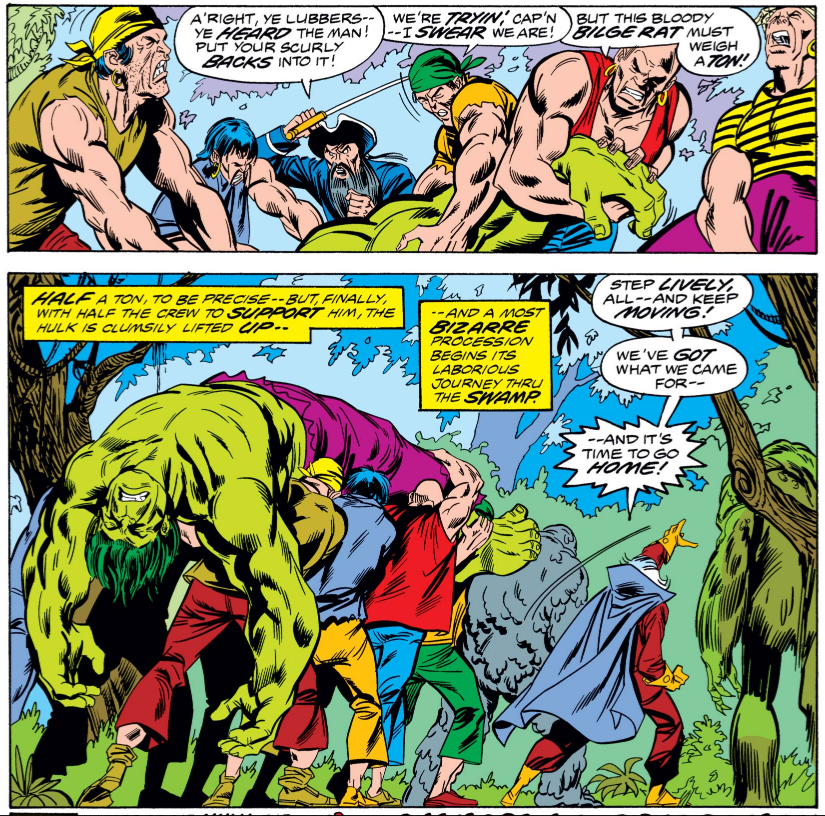
     

    MuseumCarry


    The Hulk is slowly dragged into the Collector’s ship, which also doubles as his mobile menagerie. The pirates drag him through the halls of the Collector’s ship, until they reach a special exhibit that was designed to look like the Florida Everglades, and place all three of his new finds inside. It had been the sole home of the Glob before he escaped, but now he gets two new cell-mates, and they aren’t going to be able to escape because the Collector has attached some special manacles to their legs that will keep them inside the little Everglades biome forever. And, with that taken care of, he rewards his crew of pirates by using a special invention to shrink them down and place them in a miniaturized version of their ship, which is in a bottle of course, and puts them back on display where they’ve apparently been for hundreds of years.

    The Collector then wanders off, cackling at his villainy, I guess to do some sort of inventory, leaving behind the Glob, the Man-Thing, and the Hulk. But, it seems like the Collector maybe doesn’t know much about the Hulk, because left unattended to the sleeping form of the jade monster slowly starts to transform back into Bruce Banner. And, noticing this change, the Man-Thing wanders over and begins delicately stroking Banner’s face until he wakes up, panicking. Bruce doesn’t remember where he is, but it sure seems like the Everglades, so he begins walking away from Man-Thing and Glob, looking for the blonde guy he was trying to protect. But, when he reaches the edge of his little pen he ends up slamming into an invisible wall, realizing that he’s in some sort of museum. However, he also realizes that the manacle on his leg seems to have been programmed to cage the Hulk, and now that he’s just Bruce Banner he’s able to slip out of it, and walk right out of his invisible cage, into the Collector’s collection.


    MuseumCollection


    The whole thing is really blowing Bruce’s mind, as he wanders around and finds objects from antiquity, myth, and alien civilizations. But, things really get unexpected when he comes across another little diorama that’s made up to look like an ancient Arabian home, complete with a woman inside. And, a real life woman. In fact, it seems to be Scheherzade, the protagonist of the One Thousand and One Nights story, who is apparently a real person, and who has been captured by the Collector, forced to tell him stories every night. Bruce is pretty shocked by this, and she’s pretty shocked to see a person outside of their cage. She manages to calm Bruce down, and begs him for help, summoning a group of other sentient beings who are trapped to also plead their cases, including a Union soldier, a satyr, a Roman Centurian, and some goofy looking alien guy.

    They beg Bruce to help them escape, telling him that they’ve been captives of the Collector for untold time, and he decides that he has to do whatever’s in his power to free them. Bruce then begins marching off, eager to find some way to save these poor souls, and walks right into the Collector, who isn’t pleased to see Bruce out of his terrarium. But, instead of just attacking Bruce, he ends up striking a conversation with him, because it turns out the Collector is incredibly lonely, and just wants a friend. He also summons a guy called Akbar who was once the bodyguard of Kubla Kahn, just in case Bruce gets any funny ideas. But, by and large the Collector seems to enjoy Bruce’s company, and ends up striking him an offer. He has an elixer which he claims will permanently remove the Hulk from him. And, he’ll give it to Bruce if he agrees to stay in the Collection and be his friend. And, Bruce’s answer is kind of surprising.
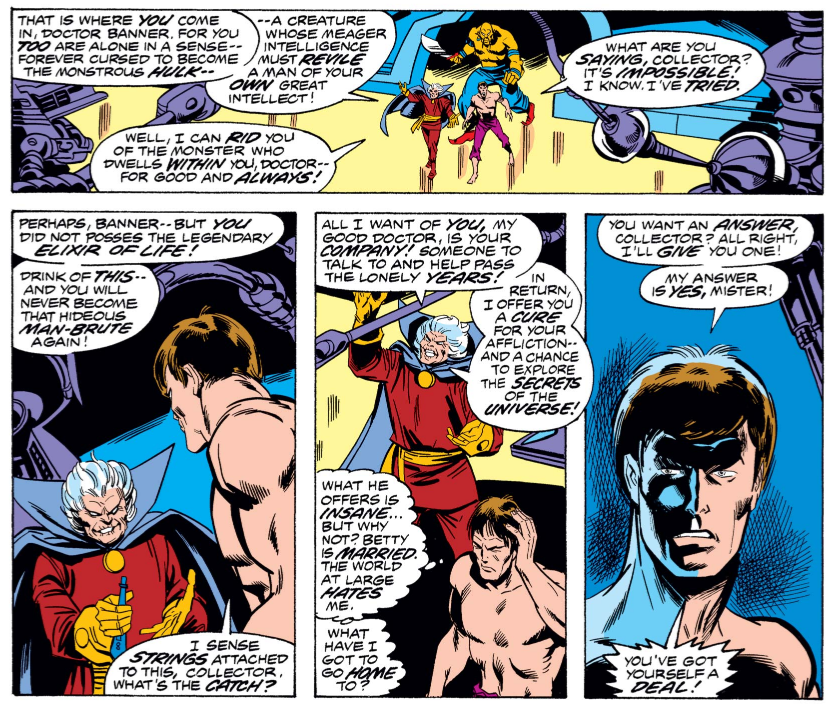
     

    MuseumCure


    So, leaning into his emo streak, Bruce decides that there’s no reason he should return to Earth, because everyone there sucks, and ends up agreeing to the Collector’s terms. However, all of this emotional turmoil has caught the attention of one of the newest additions of the collection. Because, in case you weren’t aware, a big part of the Man-Thing is that he’s an empath, feeding off of powerful emotions. So, feeling everything that Bruce is going through is like catnip to him, causing the big monster to shamble out of his confines, his gooey leg just melting right through his manacle, letting him free himself from his pen. And, seeing a good course of action, the Glob ends up doing the same thing with his manacle, following Man-Thing out into the collection.

    The two begin lumbering through the collection, drawn to Bruce’s emotions, which manages to catch the attention of some of the Collector’s guards. They raise an alarm, telling Collector that it seems like Bruce has freed his two cell-mates along with his escape, causing the Collector to renege on his promise. The two start fighting, and Bruce makes a move towards the Collector, causing Akbar to attack him, punching him across the room. Which, was a miscalculation, because this causes Bruce to transform into the Hulk, who is quite a match for Akbar. Hulk and Akbar fight for a bit, but it’s really a forgone conclusion that the Hulk is going to win. He’s the strongest one there is after all.


    MuseumPunch


    The Hulk makes quick work of Akbar, and turns his attention to the Collector, who he immediately recognizes as someone who has given him grief. So, the Hulk prepares to pummel the Collector into the ground, causing the Elder of the Universe to try and make a deal. He shows Hulk the elixer that he tried to bribe Bruce with, promising a way to remove Banner from his life forever. But, surprisingly, the Hulk is not into this idea. Not because he values Bruce Banner, but because he wants to be the one to defeat Banner on his own, not using some magic potion. So, the Hulk crushes the elixer, and prepares to continue pummeling the Collector. However, the Collector thinks fast, and manages to summon a force field of energy which he claims will keep the Hulk imprisoned so that he can deal with Man-Thing and the Glob.

    The Collector leaves the Hulk to do his best to smash out of the force field, while he goes and gets a group of gladiators to track down and capture his missing exhibits. Which, doesn’t prove that difficult, what with them being slow-moving mounds of goo. The gladiators begin attacking Man-Thing and the Glob, but as you might guess, it doesn’t work well. Their weapons and nets slip right through their bodies, and it all just starts to seem fruitless. And, that anxiety and fear at realizing that their tactics are having no effect against two literal monster starts to cause them to become afraid. Which, is a problem, because as we all know, whatever knows fear burns at the Man-Thing’s touch.


    MuseumFear


    And, while the Collector and his men are distracted with Man-Thing and Glob, we see that the Hulk has been insanely bashing the force-field repeatedly, growing more and more furious. And, since the Hulk gets stronger the madder he gets, he eventually becomes strong enough that he manages to smash through the force field. He’s pretty pleased by this action, but doesn’t really realize the full ramifications of destroying this piece of technology. Because apparently the power used to run the force field had been draining all of the other systems, and him crashing it caused a cascading effect throughout the collection, causing all of the exhibits to lose power, freeing the inmates.

    They end up charging throughout the collection, getting ready to fight against the Collector and his men. And, as a small war breaks out the Hulk comes shambling into the room, pissed off at everyone. And, realizing that things have fallen apart, the Collector decides that it’s time to cut his loses and flee. He begins abandoning his men and his collection, which catches the attention of the Hulk. He goes rushing off after the Collector, wanting vengeance, when he’s stopped by Scheherazade. She recognizes his pants, and assumes that this is still Banner, welshing on their agreement. She reminds the Hulk of their agreement, and calls him a hero, which manages to make the giant agree to help them.


    MuseumHero


    And, now that the Hulk has decided that he’s going to help these people, he leads his newfound friends to freedom. Because as soon as the Collector ran for his life his gladiators gave up, letting everyone leave the museum. But, as everyone starts looking for an exit, one exhibit trails off. The Glob has no interest in escaping. He only wants vengeance. So, he begins shuffling through the ship, tracking down where the Collector has gotten off to. And, he ends up locating the Elder inside his control room, desperately trying to repair his technology so that he can recapture his possessions and go back to normal. And, he’s distracted enough that he doesn’t notice the Glob come shuffling into the room, sneaking up behind him and getting ready to have bloody revenge on his captor.

    Meanwhile, the Hulk has been leading his little crew of captives through the collection, and they’ve finally found a way out. The Hulk is able to break his way out of the ship, lowering the captives down onto the ground for freedom. At which point they all begin to cheer for the Hulk, after having saved them all. Hulk seems most pleased that he’s gained the affection of Scheherazade, and actually seems quite content with the world. Which, of course can’t last. Because it turns out that something in the Collector’s ship was keeping them all alive, and now that they’re out of the ship they’ve all started rapidly aging. The Hulk watches in horror as all of the captives begins aging into dust around him, even Scheherazade. And, as everyone around him dies, the Hulk just stands there, mortified, while Man-Thing feeds off of his emotions until they get too dull, and he goes marching off into the swamp, leaving the Hulk with his pain.


    MuseumEnd


    The world is a bad place right now, and sometimes you just need to distract yourself with some comfort food. And, insane Marvel stories are a great source of comfort for me, falling into the familiar and bizarre trappings that the House of Ideas used to pump out at a staggering rate. Which makes this story just so much more delightful. Because it’s wonderfully bat-shit crazy. Like so many of the Marvel stories I highlight here on the site, it’s just a prefect distillation of what I love about the Marvel Universe. The way that it has so many characters, most of which seems like they shouldn’t interact, only to blend them all together in a way that works. The Hulk and Man-Thing are characters that sort of feel like they could go together, but tossing the Collector into the mix is that extra little spice that makes this story a work of insane art. I love the Collector in comics and seeing him capture Hulk and Man-Thing with an army of pirates only to get involved in an insane prison break is just an absolute delight. It’s just a bunch of characters that I enjoy, hanging out with each other and playing around with the nonsense of the Marvel universe, exactly what I’m here for. Plus, we get some interesting insight into the Hulk and Bruce, especially in the form of that whole elixer of life thing. It’s very sad that Bruce would be willing to leave Earth forever as essentially a slave for conversation, because there’s just nothing left for him on Earth. And, the idea that the Hulk doesn’t want to get rid of Banner in an easy way because he wants to be the one to destroy him is intense. And, that final punch to the gut, having the Hulk finally come across someone who sees him as a hero, and wants to befriend him, only for that person to literally die in his arms, it just depressing. But, it works so well, and it’s that bit of melancholy that helps make the silly goofiness pop.


    The Incredible Hulk #197-198 were written by Len Wein, penciled by Sal Buscema, inked by Joe Staton, colored by Glynis Wein, lettered by John Costanza, and edited by Len Wein and Marv Wolfman, 1976.



    MuseumTag


  • The Lovebirds and Out of Depth Crime

    LovePoster


    Not to keep beating the same dead horse, but boy are we starved for new movies right now. Obviously there are a whole bunch of more important things going on, but as someone who has historically used the theatrical experience to cope with the stresses of the world, having that get removed, and to have the entire concept of seeing movies again in the theater placed in a gray area, it’s been hard. The entire future of the American movie industry is up in the air, with most of the major studios seemingly making some worrying calls right now. Because it sure seems like they’ve decided that major blockbusters are going to be pushed into next year, and everything under a certain budget is just going straight to VOD, which is going to be pretty hard to reverse whenever we get back to something approaching normal. People are increasingly finding themselves unlikely to even visit a movie theater, and now that they’re getting new movies that were supposed to be released into theaters just dropped into their homes, I worry that that’s going to become even more of a barrier to major releases. And yet, as someone who is desperate to see new movies, I’m also jumping at the chance to see anything I can. During the first chunk of the year, when things seemed like they weren’t all going to fall apart, I remember seeing trailers for the film we’re discussing today, the Lovebirds, and not being overly blown away. It looked fine, but nothing that I was really going to go out of my way to check out. I figured that if it was released on a slow weekend where nothing else interesting came out I’d go check it out, otherwise it would get relegated to an end of the year clean-up when I try to cross things off my list. But, if it’s going to be released straight to Netflix I was going to run to it like an oasis in the desert. And, it at least managed to quench that thirst.
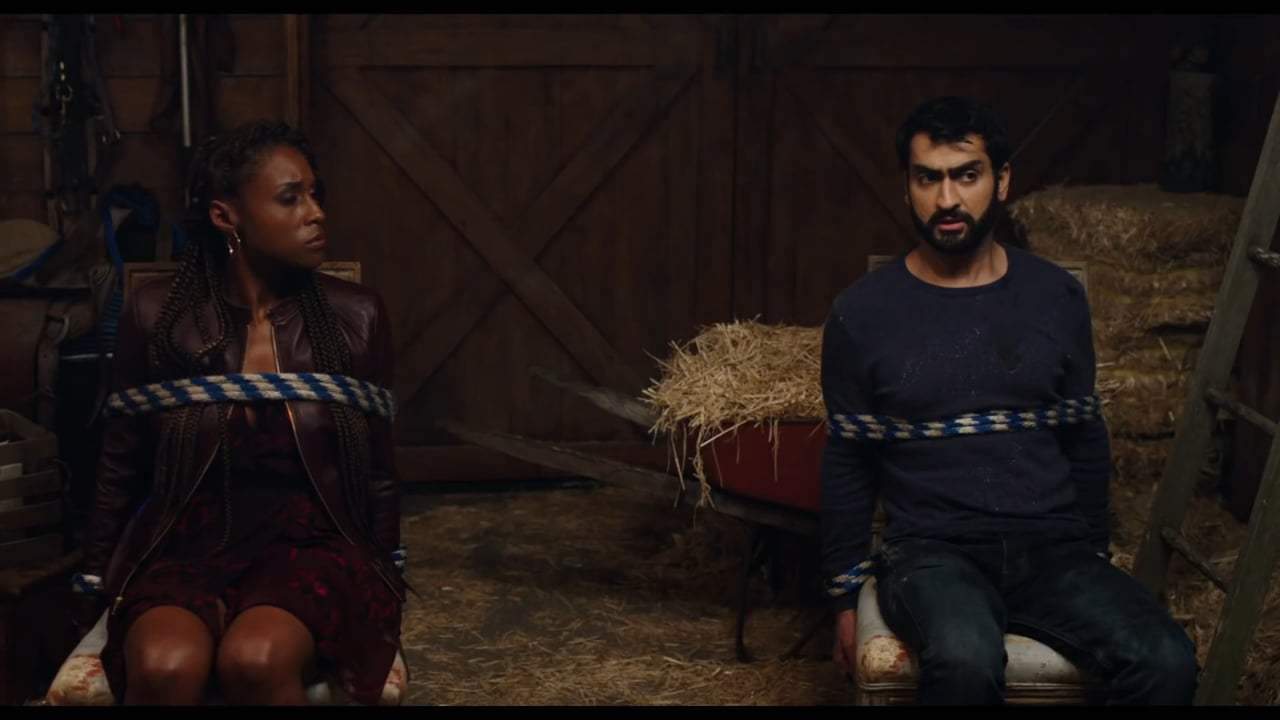
    The film tells the story of Jibran and Leilani, a couple living in New Orleans who have been together for a few years, and seem to have reached the end of their relationship. They were quite in love at one point, but things have kind of fizzled out, and as they prepare to go to a dinner party with some friends they kind of realize that their relationship is over. However, while distracted by this heavy conversation Jibran ends up hitting a man on a bike with his car. The two begin panicking, until the man gets up and flees, only for a man claiming to be a cop to come to their car and commandeer it. They sit there stunned as the cop leads them on a high-speed chase, ending with him running the man on the bike over, repeatedly, and fleeing the scene. It’s at this point that they realize that they’re not accessories to murder, and make the decision to flee rather than get arrested, because their story seems to unbelievable. However, while checking to see if the guy on the bike was alive, they take his phone, and while trying to get their heads straight at a diner they find an upcoming event on the man’s phone. So, they decide to go to the bar for the meeting, hoping to get a clue as to who this person was, and who may have wanted him dead. Unfortunately, that just gets them into the path of a Congressman and his wife, who capture Jibran and Leilani, assuming that they’re working for the guy on the bike, who was apparently blackmailing them with some worrisome photos.

    Jibran and Leillani manage to escape the Congressman and his wife, and in the process get hold of an address that seems to belong to the guy on the bike. So, they head to his apartment, only to find it full of frat-boys having a party. They try to interrogate one of them, who admits that they all worked with the bike guy in a blackmail scam, and he gives them some of the photos, which appear to be taken at a secret society. However, the man who killed the guy on the bike arrives, kills all the frat boys, and Jibran and Leilani are forced to flee again, this time heading back to the party that they were on their way to in order to get an IT guy they’re friends with to open bike guy’s phone. And, in the process they learn about a powerful secret society known as Sacrarium which is having a meeting that night. So, the two get dressed up in black-tie, and head to the party using bike guy’s credentials. But, right as an orgy is about to break out they’re found out as intruders, and are about to be attacked when the police show up. It turns out the cops have been looking into this organization for a while, and they’ve also been looking for Jibran and Leilani, who they were able to clear of charges through surveillance cameras almost immediately, meaning this entire chase was unnecessary. The pair are allowed to go free at that point, dealing with their crumbled relationship and the strange night they had, until the man who killed the bike guy shows up. It turns out that he’s a corrupt cop who has been working with Sacrarium, while also blackmailing them, and Jibran and Leilani are lose ends. He attempts to kill them, but they manage to overpower him, and alert the police to come help them. At which point they decide to give their relationship another try.


    LoveCult


    Listen, in an alternate universe where this pandemic didn’t happen, and I ended up seeing this movie in a theater in April, I probably wouldn’t have thought too much about it. It’s not a bad movie or anything, it’s just kind of fine. It gets a little too melodramatic at points with their relationship squabbles, has a few tired jokes, and just kind of feels like a re-tread of that Date Night movie from a few years back. But, it also has two terrific performances from Kumail Nanjiani and Issa Rae, it has its fair share of good jokes, and it actually manages to handle the whole twisty crime story pretty well. But, we live in a word where there’s been a distinct lack of new movies to check out, and kind of specifically a lack of new comedies. Which probably made me enjoy this movie a whole lot more than I normally would have. I already pay for Netflix, so why wouldn’t I check this out? And, I’m glad I did. It’s not perfect, but it doesn’t need to be. It’s  studio comedy, and it succeeded in making me laugh a couple times, which is honestly all I need from a comedy movie during these dark times. I will probably never think about it again, but it made me happy for an hour and half, so if that’s something you’re looking for, check it out.

    There’s been a recent trend in Hollywood comedies, a genre that seems to be rapidly dying before our eyes, that essentially tries to take a comedy movie, and smash it into a thriller. It’s not a new concept, but we’ve had quite a few solid examples of this formula in recent years, probably most well done by Game Night. And, it’s one that I actually find myself liking quite a bit. I have a deep love of characters from one genre seemingly being dropped into another. It’s probably because of my adoration for the Big Lebowski, but there are so many examples of what I usually like to call “the Accidental Detective,” a story where a normal person from our reality is dropped into an insane noirish crime/espeionage plot, and it almost always leads to hilarity. This movie manages to take two people in a fairly realistic relationship, full of self-doubt and misunderstandings of what a real human relationship is supposed to be versus the expectations that we have for them, and drops them into a story where they eventually uncover an Eyes Wide Shut style sex cult. And, it’s funny! These types of stories are hoot, and really show how ridiculous movies that play with these sort of story beats seriously are, because anyone in their right mind would be completely incompetent and doing their best not to flip out the entire time too.


    The Lovebirds was written by Aaron Abrams and Brendan Gall, directed by Michael Showalter, and released by Netflix, 2020.


    LoveShack

  • 8. Johnny Guitar

    GuitarPoster


    Well, after dealing with fairies, fauns, and fascists it looks like it’s time to change things up pretty drastically and take a trip to the Old West. This week I’ve pulled a film that’s long been on my “to-watch” list, but one that I’m seeing for the first time, the cult favorite Western Johnny Guitar. I’ve heard about this movie for quite some time, often ending up on lists of favorite Westerns, while also topping lists of cult movies, weirdo campy masterpieces, and movies with insane female-performances at the helm. I didn’t really know anything at all about the film other than the idea that it was a Western, it was held in fairly high esteem, and it starred Joan Crawford putting in one of the most “Joan Crawford” performances she ever gave. Other than that I went it basically blind. Director Nicholas Ray is someone who I haven’t really had that much experience with, but everything I’ve seen of his has been terrific. In a Lonely Place is a terrific noir, and one that manages to really play with Humphrey Bogart’s movie-star persona in a really fascinating way, and Rebel Without a Cause really is as transfixing and interesting as its reputation leads you to believe. So, that also helped me go into Johnny Guitar with high hopes, because it certainly seems like Ray is a director whose filmography I need to catch up on. And, after checking out this film I definitely need to seek out more Nicholas Ray films, because this is the third fantastic movie of his I’ve seen. Johnny Guitar is a wonderfully weird little film that grabs you from the first minute and keeps you enthralled until its last moments, absolutely blowing me away that a movie like this was released in 1954.

    The film actually began life in order to fulfill some contract requirements, because Nicholas Ray and Joan Crawford were scheduled to make a film together which fell apart due to a lackluster script that just couldn’t be fixed. So, instead Crawford decided to push forward an adaptation of Johnny Guitar, a novel written by Roy Chanslor which had actually been dedicated to her, and that she held the rights to. So, she got the film set up at Republic Pictures and got Ray hired as the director. Unfortunately, as is seemingly so often the case with films that stared Joan Crawford, it wasn’t an easy shoot. Nicholas Ray and Joan Crawford were seemingly having an affair at the time, and he allowed all of her worst impulses to take over, leading to her dominating the other cast members, and garnering a sour reputation with most of them. It also didn’t help that Mercedes McCambridge, who was brought on to play Crawford’s nemesis in the film, seemed to dislike Crawford quite a bit due to love triangles the two had been in. Ray seemed to think that having this sort of background made their feud in the film that much stronger, but it also seemed to lead to a rather hostile working environment. The two fought about their issues, McCambridge’s alcoholism, and a specific event where Crawford threw some of McCambridge’s clothes in the street. And, all of this came together to make a film that didn’t make much of an impact at the time. It got bad reviews, and made a bit of money, but largely seemed to rub people the wrong way. However, over the years the film’s reputation started to change, and it has gone on to be considered one of Ray’s finest films, and a classic of the Western genre. It also holds the distinction of becoming a personal favorite of towering figure of the French New Wave scene, Francois Truffaut. The film was held up by European art directors as an example of art that could sometimes escape the American studio system, and eventually Americans caught up with this appraisal. And, let me tell you, it’s a fascinating film.


    GuitarCast


    The film begins with the titular Johnny Guitar, a drifter making his way towards and Arizona cattle town at the behest of a former lover of his, a woman named Vienna. She has set up shop in a saloon that she built with her own money after seducing some men from a railroad company and learning that the area around this saloon would soon become a town, positioning herself as a prominent figure in a new town. However, the locals haven’t taken too kindly to Vienna, partly because she’s a woman owning her own business, partly because she seems to have had a history of prostitution, and partly because she’s grown chummy with a group of men that the town assume are outlaws. The Dancin’ Kid, Bart Lonergan, Turkey Ralston, and Corey claim that they work in a secret silver mine, but cause lots of problems in the town, casing the various townsfolk to despise them, and Vienna by association. So, she’s reached out to Johnny Guitar, asking him to come play his guitar in her saloon, while secretly hoping that he’ll help protect her, because she knows that he’s actually a rather infamous gunslinger named Johnny Logan, who is trying to escape his past. However, as Johnny reaches the town, things start to fall apart, because a wagon has just been robbed at gunpoint by a group of outlaws.

    The various townsfolk, seemingly led by a woman named Emma Small, arrive at Vienna’s saloon, ready to hang her and the Dancin’ Kid’s gang. They’re convinced that the gang held up the stagecoach, and think that Vienne was involved in the crime. Vienna tries to calm the situation down, but Emma’s virulent hatred for Vienna becomes too hot to handle, and an argument begins that quickly gets out of control when the Dancin’ Kid and his men just so happen to show up to get drunk. At which point John McIvers, the leader of the town, declares that Vienna and the Dancin’ Kid gang need to vacate the town in 24 hours, or else be killed. Vienna is furious about this, since she didn’t do anything wrong, and knows that Emma Small is just making all of this happen because she’s in love with the Dancin’ Kid, and hates that Vienna and he have been having an affair. But, after talking it through with Johnny, she seems resigned to the fact that the world isn’t fair, and that it’ll probably be for the best that she just moves on, and tries to find another life somewhere.

    Unfortunately, the Dancin’ Kid and his gang don’t reach the same conclusion. They didn’t actually rob that stagecoach, but they become so incensed that they decide they should rob something. So, the next day they head to the town bank to rob it before skipping town. And, it just so happens that Johnny and Vienna were in the bank at that moment, collecting all of Vienna’s money. So, when the townsfolk learn of the robbery, and Vienna’s presence, they decide that she was masterminding the whole thing. The Dancin’ Kid gang try to escape town, but are blocked by some railroad expansion, causing them to go to their secret hideout, while the youngest member of their group, Turkey, is wounded and left with Vienna. Vienna tries to hide the boy when Emma and the townsfolk appear, but they end up finding Turkey, and decide to hang him and Vienna. They do manage to kill Turkey, but before Vienna can be hanged she’s saved by Johnny, and the two flee to find the Dancin’ Kid and his gang, hoping to get help from them. The Dancin’ Kid is willing to help Vienna, because he’s in love with her, but Bart Lonergan has grown a quick dislike of Johnny Guitar, and ends up finding Emma and the townsfolk, showing them where the secret hideout is. Bart and Corey end up killing each other after Corey learns of Bart’s betrayal, and the townsfolk arrive to capture Dancin’ Kid, Vienna, and Johnny Guitar. But, Emma wants to be the one to kill Vienna, and the two end up in a duel, which ends with Vienna getting shot in the shoulder. The Dancin’ Kid then tries to stop Emma, getting shot in the head in the process. At which point Vienna shoots Emma, killing her instantly. The townsfolk, horrified at what has happened, then let Vienna and Johnny Guitar leave, not wanting any more bloodshed.


    GuitarEnd


    It’s always a great experience to learn about a film that has gained a cultish appreciation and following, and then immediately realize why it’s been given that sort of affection. Sometimes cult movies get that sort of designation because they’re laughably bad or weird, but sometimes it’s because it’s just a strange little film that was years ahead of when it was released. And, that’s kind of the case with Johnny  Guitar. This is a film that I’m absolutely stunned was released in the mid 1950’s, a time when the genre was so dominated by cookie-cutter stagnation. Because this really is unlike any Western from the era I’ve ever seen. It’s full of lavish colors and production design, somewhat arch performances, and some truly shocking subject matter. I couldn’t quite believe it when the film actually executes Turkey, and the final shootout with not one but two brutal head-shots really shocked me. Most American Westerns of the time seemed to portray a mythical West, full of pulpy square-jawed heroes fighting villainous caricatures, but this is a movie that seemed to portray the West as the chaotic and ugly place that it really was, which just really doesn’t seem to be something that was happening in 1954. Joan Crawford is a very strange actress, one who I’ve always enjoyed when I see her act, but I almost hesitate to call her acting “good.” It’s very unique, and this is perhaps the most “Joan Crawfordy” performance I’ve ever seen her put in, and it works beautifully in the film. Everyone’s great in the movie, putting in these wonderfully weird performances that help bring the surreality of the story to life, but it’s clearly Crawford who walks away with the movie.

    I read some negative reviews of the time that seemed to hold Crawford and her movie star persona against the film. She was thought of as a very modern actress, and people just didn’t seem to want to see Crawford in an Old West setting. But, what remains the most shocking about this film is the way that Crawford is portrayed. Like I said, so many Westerns of this era are pretty cookie-cutter. Vaguely handsome white cowboys defend the virtue of their family, fighting against the evils of the world as portrayed by American Indians or villainous outlaws. And yet, here’s a film that is completely dominated by the power of two women. Yeah, Johnny Guitar and the Dancin’ Kid seem to be fairly standard Western heroes/villains, but they’re both love-sick dopes who are being manipulated by one of the most fascinating female protagonists I’ve ever seen in a Western. Vienna is a protagonist who is taking charge of her life, whatever way she can. She’s realized the power she has over men, and since this is a world heavily dominated by men she uses that power to the full extent that she can to get what she wants. But, she’s not looking for power or revenge. She just wants something that’s hers. She built her saloon herself, hired a family of employees, and just wants it to be the best damn saloon it can be. But, she’s caught up in a frustrating love-triangle that sours and ends with the death of five people. And, by the end of the film, she’s forced to give up everything that she’s built because of the simple-mindedness of those around her, and heads off into the sunset to try and pick up the broken pieces of her life. It’s not fair, but it’s the way that America works sometimes.


    Johnny Guitar was written by Philip Yordan, directed by Nicholas Ray, and released by Republic Pictures, 1954.


    GuitarPiano